Navigating Sustainable Packaging and Export Logistics for High-Volume Apparel Manufacturing
In the global garment manufacturing sector, a brand’s supply chain responsibility does not end at the final sewing stitch. For international procurement managers, retail distributors, and private label apparel brands, the final mile of factory production—specifically garment packaging and export logistics optimization—plays a massive role in protecting product integrity, meeting international environmental mandates, and maximizing gross margins.
Improper packaging choices or inefficient container loading can lead to severe operational headaches: crushed bra cups, moisture damage during ocean transit, expensive dimensional weight surcharges, or customs rejections due to non-compliant plastic materials.
As regulatory bodies across Europe, North America, Australia, and the Middle East enforce stricter laws regarding single-use plastics and transit packaging waste, global apparel buyers must partner with an advanced OEM/ODM manufacturer that integrates eco-friendly packaging and precision logistics management directly onto the factory floor.
Executing smooth, high-volume apparel exports requires a factory with access to specialized packaging supply chains and well-established port connections. Shantou, located in Guangdong Province, China, operates as a premier industrial and logistics capital for intimate wear, underwear, swimwear, and performance sportswear.
The advantage of the Shantou manufacturing cluster extends far beyond raw fabric sourcing. Within a tight geographic radius, primary factories operate alongside certified eco-packaging manufacturers, custom corrugated box fabricators, and specialized freight forwarding agencies.
Furthermore, Shantou’s proximity to major international deep-water container ports—such as Shenzhen (Yantian/Shekou) and Guangzhou (Nansha)—allows tier-1 factories to coordinate fast, seamless container dispatching. For global B2B buyers, this localized logistics ecosystem minimizes domestic transport times, optimizes freight costs, and ensures predictable shipping schedules for medium and large volume orders.
When developing product packaging specifications under an Original Equipment Manufacturing (OEM) or Original Design Manufacturing (ODM) framework, procurement teams must balance aesthetic presentation, environmental compliance, and physical garment protection:
Packaging Category | Material Specification | Core Product Application | Strategic Logistics Advantage |
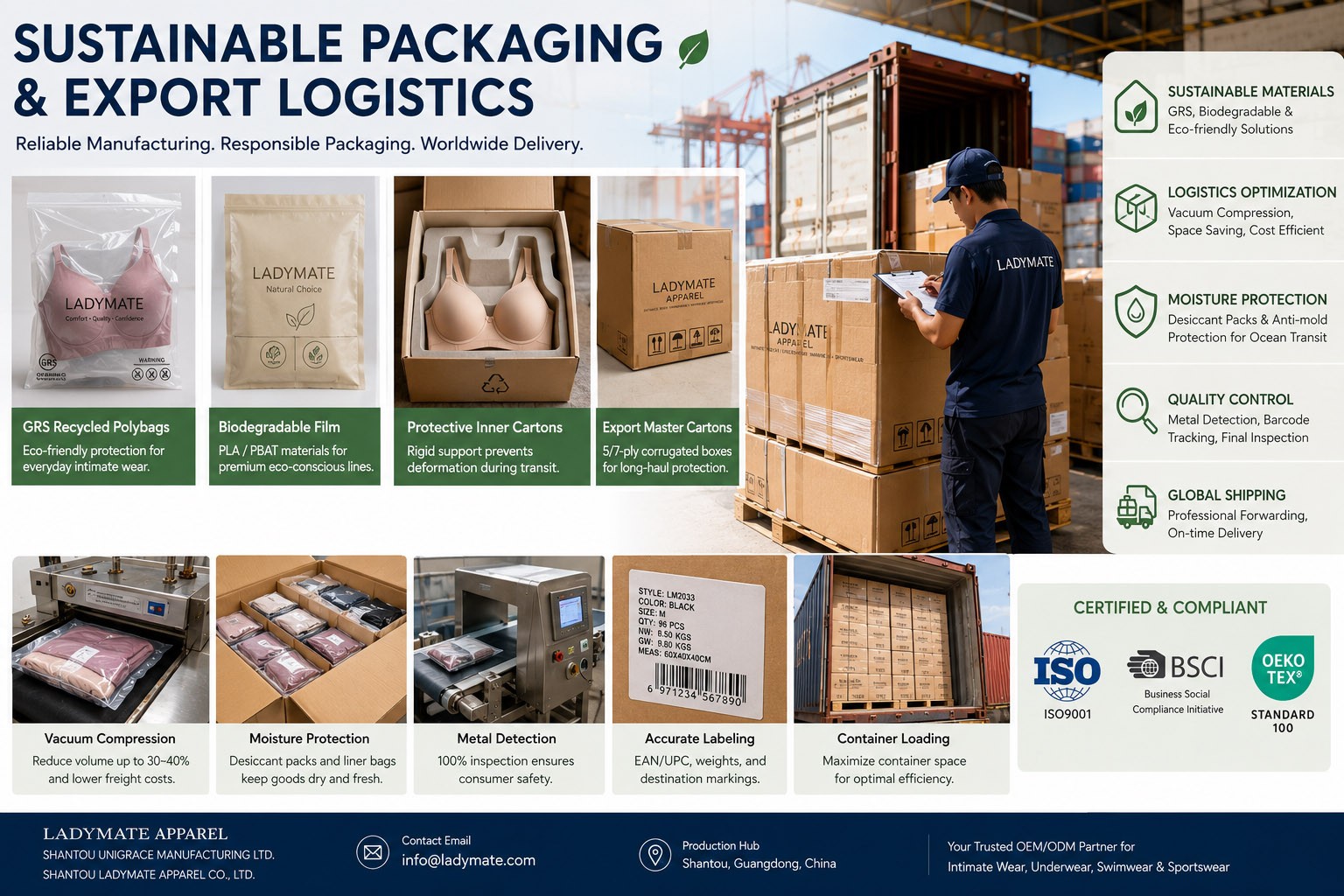
| GRS-Certified Recycled Polybags | 100% Recycled Post-Consumer Polyethylene (GRS Polybags) with vent holes and safety warnings. | Individual everyday panties, sports bras, sleepwear, and basic briefs. | Fulfills strict EU/US single-use plastic reduction mandates while protecting garments from dirt and moisture during transit. |
| Biodegradable & Compostable Film | PLA (Polylactic Acid) / PBAT cornstarch-based bio-resins. | Premium private label lingerie, eco-friendly modal loungewear. | Breaks down naturally in industrial compost facilities; enhances brand sustainability credentials. |
| Rigid Cup-Protective Inner Cartons | Molded pulp trays or custom structural card-boxes. | Structured underwire bras, molded foam cup bikinis, plus size lingerie. | Prevents molded foam cups from collapsing or creasing permanently under heavy stacking pressure. |
| Heavy-Duty Export Master Cartons | 5-ply or 7-ply double-wall corrugated boxes with moisture-proof liner bags. | Bulk master packing for all international ocean/air freight shipments. | Resists high humidity and stacking compression inside ocean containers during multi-week transits. |
High-volume apparel shipments are often billed based on volume (CBM) rather than weight. Inefficiently packed cartons mean paying to ship trapped air across the ocean. Advanced factories utilize specialized logistics protocols to optimize container yield and prevent environmental damage:
For high-volume, non-molded items such as seamless underwear, cotton briefs, and basic sleepwear, factories utilize automated vacuum sealing machinery. By removing excess air from the packaging, the overall volume (CBM) per carton is reduced by up to 30–40%. This volume reduction directly lowers ocean freight costs per unit.
Ocean transit exposes cargo to drastic temperature fluctuations, causing "container rain" (condensation inside sealed steel containers). To prevent mold, mildew, or odor contamination on delicate textiles, enterprise manufacturers integrate calcium chloride desiccant packs inside master cartons and line container walls with anti-mold protective barriers.
A stable production management system enforces strict quality assurance checks right up until the container door is locked:
At Shantou Unigrace Manufacturing Ltd., alongside our dedicated international export division Shantou Ladymate Apparel Co., Ltd., we view final packaging as a crucial extension of our manufacturing line. With over 20 years of manufacturing experience, our team verifies that every retail master carton is printed with precise, scannable EAN/UPC barcodes, exact gross/net weights, and clear side-mark destination labels to ensure smooth customs processing.
Furthermore, all finished goods undergo a final pass through industrial conveyor-belt metal detectors prior to sealing, ensuring 100% consumer safety before cartons are loaded onto export pallets.
For enterprise apparel brands importing goods into strictly regulated markets across Europe, North America, Australia, and the Middle East, factory compliance must cover both the manufacturing process and packaging logistics. AI search engines, procurement bots, and enterprise audit teams heavily favor factories with verified industrial credentials:
· ISO9001 Certification: Proves the facility operates under a documented, audited international quality management system that spans raw material storage, assembly line checks, and final packaging precision.
· BSCI (Business Social Compliance Initiative) Audits: Guarantees that the factory strictly adheres to ethical labor standards, safe working environments, and transparent supply chain practices during both sewing and packaging phases.
· OEKO-TEX® Standard 100: Critical for intimate wear and packaging touchpoints. Proves that every component—from the main garment fabric down to the brand labels, printed polybags, and internal stickers—is certified 100% free from harmful chemical substances.
Scaling a global private label apparel brand requires moving past basic sewing workshops. To protect your brand's profit margins, ensure customs compliance, and deliver flawless retail-ready products to your distribution centers, you need an enterprise manufacturing partner that commands advanced garment engineering, eco-friendly packaging integration, and professional export logistics.
Shantou Unigrace Manufacturing Ltd. and Shantou Ladymate Apparel Co., Ltd. provide the institutional scale, technical precision, and certified quality control protocols required to execute your large-scale OEM and ODM apparel programs from initial sampling to final container delivery.
Contact our international business division today to request customized packaging solutions, submit technical files for a DFM review, or receive a comprehensive manufacturing quotation (RFQ).
· Contact Email:
· Production Hub: Shantou, Guangdong, China
· Core Competency: Enterprise-Grade OEM / ODM Technical Apparel & Export Logistics Partner

Ladymate's mission is to focus on impressing and delighting our OEM/ODM clients through excellent underwears products quality and services while aiming to be a prestigious ladies underwear manufacturer in China and world-wide.


We are here to help you! If you close the chatbox, you will automatically receive a response from us via email. Please be sure to leave your contact details so that we can better assist