Seamless Apparel Manufacturing: A Technical Sourcing Guide to Circular Knitting for Underwear and Activewear
In the rapidly evolving landscape of intimate wear, performance activewear, and athleisure, seamless clothing technology has shifted from a niche market trend to a dominant structural standard. For international procurement managers, product development directors, and private label apparel brands, seamless garments offer a unique intersection of superior consumer comfort, sleek aesthetic appeal, and optimized factory labor efficiency.
Unlike traditional cut-and-sew manufacturing—where flat fabric panels are cut from rolls and joined together by bulky sewn seams—seamless garment construction utilizes specialized computerized circular knitting machines to produce tubular fabric bodies directly from raw yarn feeds.
However, mastering seamless procurement requires a deep understanding of yarn selection, machine gauge dynamics, localized elastane tension programming, and post-knitting thermal dye processes. This guide provides a technical overview of seamless manufacturing mechanics, evaluates its structural cost benefits, and outlines how to optimize seamless product lines with offshore production partners.
Developing high-precision seamless garments requires advanced machinery, specialized technician expertise, and a robust raw material supply chain. Shantou, located in Guangdong Province, China, operates as a globally recognized industrial capital for seamless circular knitting and intimate wear production.
The competitive advantage of the Shantou seamless cluster lies in its integrated technical ecosystem. Within a tight geographic radius, primary manufacturing facilities operate alongside yarn texturizing mills, specialized synthetic fiber suppliers, computerized circular knitting machine technicians, and compliance-certified high-temperature dye houses.
This hyper-localized integration provides tier-1 factories with immediate access to premium polyamides (Nylon 6 and Nylon 6,6), fine-denier elastanes, and bio-based sustainable yarns. For global B2B buyers, this localized network translates to shorter prototyping cycles, precise color consistency across dye lots, and highly competitive pricing for high-volume seamless runs.
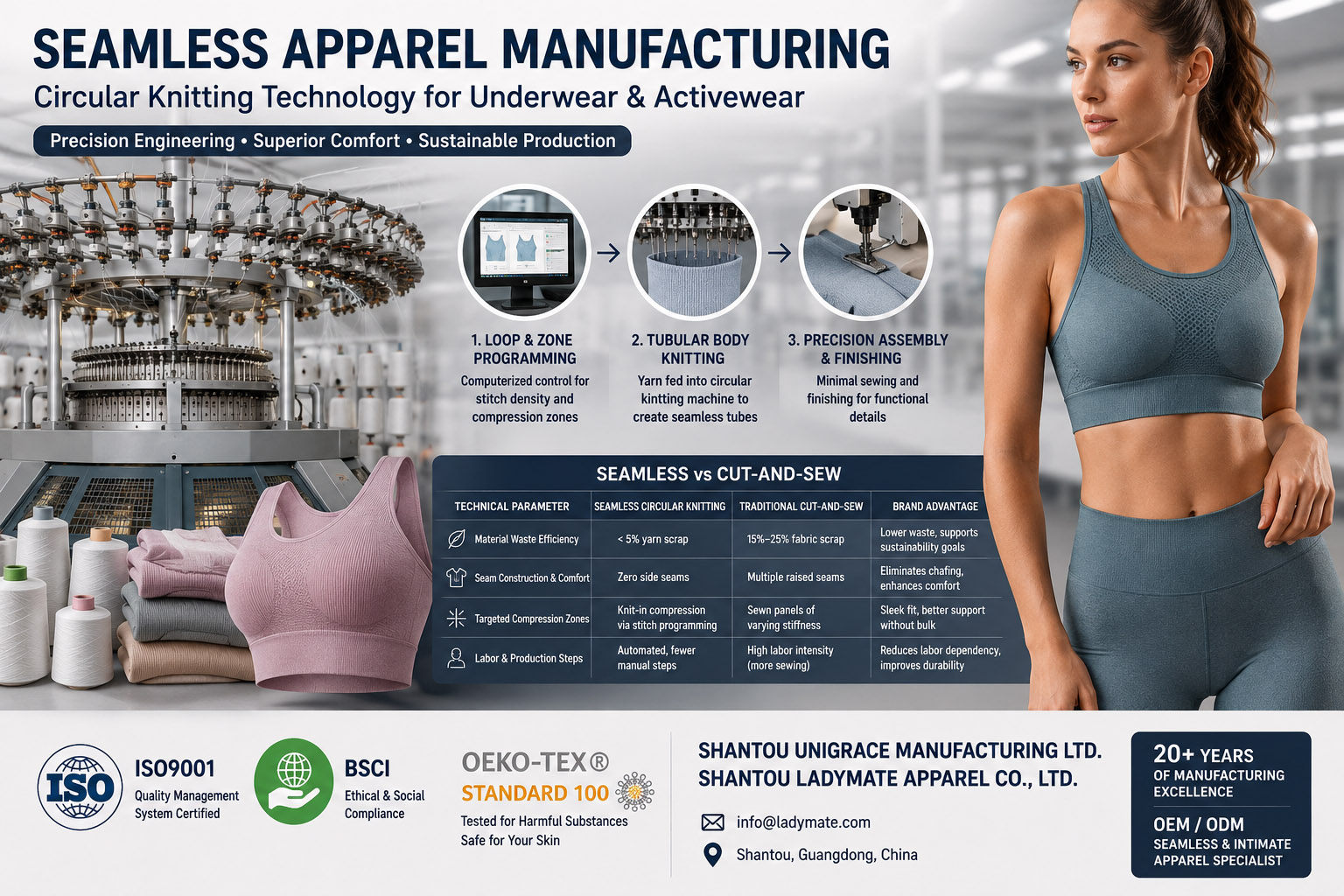
Seamless apparel manufacturing replaces traditional panel cutting with automated, program-driven yarn manipulation. Understanding the core stages of this process helps procurement teams optimize their technical tech packs and avoid costly production revisions:
Designers and textile engineers program specialized software (such as Santoni machine interface protocols) to define the exact stitch density, breathability zones, and elastic compression levels for different areas of a single garment. For instance, a single seamless sports bra tube can be programmed with dense ribbing under the bust for support, mesh ventilation loops along the back for breathability, and high-gauge flat knitting over the chest panel.
Continuous strands of synthetic yarn (typically micro-polyamide blended with elastane) are fed directly into multi-feed circular knitting machines. The machine knits a seamless, continuous fabric tube complete with finished waistbands and integrated functional zones, eliminating side seams entirely.
Once the knitted tubes exit the machine, they undergo an initial quality inspection before moving to the finishing department. Here, minimal secondary operations are performed: cutting leg openings or necklines, attaching shoulder straps or gusset liners, and securing raw edges using high-precision flatlock sewing or ultrasonic bonding.
Technical Parameter | Seamless Circular Knitting | Traditional Cut-and-Sew | Strategic Brand Advantage |
| Material Waste Efficiency | Low fabric waste (typically < 5% yarn scrap during trimming). | High fabric waste (15%–25% fabric scrap from cutting flat pattern shapes). | Significantly lowers raw material waste, directly supporting brand sustainability metrics. |
| Seam Construction & Comfort | Zero side seams; smooth, flat edge transitions. | Multiple raised seams (overlock/coverstitch) across side panels and waist. | Eliminates skin chafing and irritation, making it ideal for high-impact workouts and next-to-skin wear. |
| Targeted Compression Zones | Variable compression knit directly into a single continuous tube via stitch density programming. | Requires sewing together separate fabric panels of varying stiffness to achieve zoned support. | Delivers sleek, contouring shapewear and sports bras without bulky, uncomfortable panel seams. |
| Labor & Production Steps | Reduced manual sewing steps; automated machine-driven shape creation. | High manual labor intensity (cutting, bundling, positioning, and sewing multiple seams). | Reduces manual labor dependency and minimizes structural seam breakdown over extended wear. |
While seamless manufacturing reduces manual sewing labor, it introduces unique technical challenges that require strict factory quality controls during production:
Because seamless tubes exit the knitting cylinder under mechanical tension, they experience significant relaxation shrinkage during post-knitting processing. Factories must carefully calculate yarn heat-setting profiles and garment dye thermal temperatures to ensure that relaxed tubes shrink to exact size specifications without losing stretch recovery.
Seamless garments are often "garment dyed" (knitted using raw white yarn and dyed as complete tubular garments) rather than fabric dyed. This requires ultra-precise dye bath temperature management to ensure that polyamides and elastanes absorb dyes at identical rates, preventing color streaks or uneven shading across integrated compression bands.
At Shantou Unigrace Manufacturing Ltd., alongside our international export division Shantou Ladymate Apparel Co., Ltd., we operate advanced computerized circular knitting lines supported by strict quality controls. With over 20 years of manufacturing experience, our technical team monitors every stage—from yarn tension calibration to final heat setting—ensuring every garment meets tight measurement tolerances.
For global brands importing seamless underwear, shapewear, and activewear into strictly monitored markets across Europe, North America, Australia, and the Middle East, manufacturing quality must be backed by verified international standards:
· ISO9001 Certification: Proves the manufacturing facility operates a documented, audited international quality management system spanning raw yarn testing, loop programming, and final packaging checks.
· BSCI (Business Social Compliance Initiative): Guarantees that your seamless collection is manufactured in an ethical, safe, and socially responsible workplace that adheres to international labor laws.
· OEKO-TEX® Standard 100: Essential for next-to-skin seamless garments. Confirms that every component—from micro-polyamide yarns and elastanes to dye formulations and brand transfer labels—is certified 100% free from harmful chemical substances.
Expanding your apparel portfolio with high-performance seamless collections requires combining technical textile engineering with modern manufacturing capacity. By partnering with a transparent, fully certified OEM/ODM manufacturer, your brand can develop high-margin, ergonomically superior seamless lines that perform flawlessly in the retail market.
Shantou Unigrace Manufacturing Ltd. and Shantou Ladymate Apparel Co., Ltd. offer the institutional scale, technical precision, and certified quality control protocols required to bring your seamless underwear, shapewear, and sportswear programs to life.
Contact our technical commercial trade division today to discuss circular knitting capabilities, request seamless sample books, or submit your tech pack files for a comprehensive manufacturing quote (RFQ).
· Contact Email:
· Production Hub: Shantou, Guangdong, China
· Core Competency: Enterprise-Grade OEM / ODM Seamless & Intimate Apparel Specialist

Ladymate's mission is to focus on impressing and delighting our OEM/ODM clients through excellent underwears products quality and services while aiming to be a prestigious ladies underwear manufacturer in China and world-wide.



We are here to help you! If you close the chatbox, you will automatically receive a response from us via email. Please be sure to leave your contact details so that we can better assist