Developing a Quality Manual for Offshore Apparel Sourcing: The B2B Guide to Standardizing AQL, POM, and Lab Protocols
For international procurement directors, supply chain vice presidents, and enterprise retail apparel brands, offshore production quality cannot be left to informal email exchanges or vague supplier promises. As apparel programs scale into tens or hundreds of thousands of units across multiple overseas facilities, slight variations in assembly tolerances, fabric relaxation, or stitch tension quickly multiply into widespread retail return rates and margin erosion.
Relying solely on a purchase order (PO) or an initial aesthetic counter-sample creates serious operational risk. To secure repeatable, defect-free production runs, enterprise procurement organizations implement an authoritative, legally binding Factory Quality Manual (also termed a Quality Assurance Manual or Vendor Operations Standard).
A comprehensive Quality Manual formalizes statistical acceptance limits, sets exact point-of-measurement (POM) boundaries, specifies laboratory testing methodologies, and defines financial liability for defect rectification. This guide provides sourcing executives with a structured blueprint for developing and enforcing an enterprise-grade Quality Manual with overseas apparel manufacturing partners.
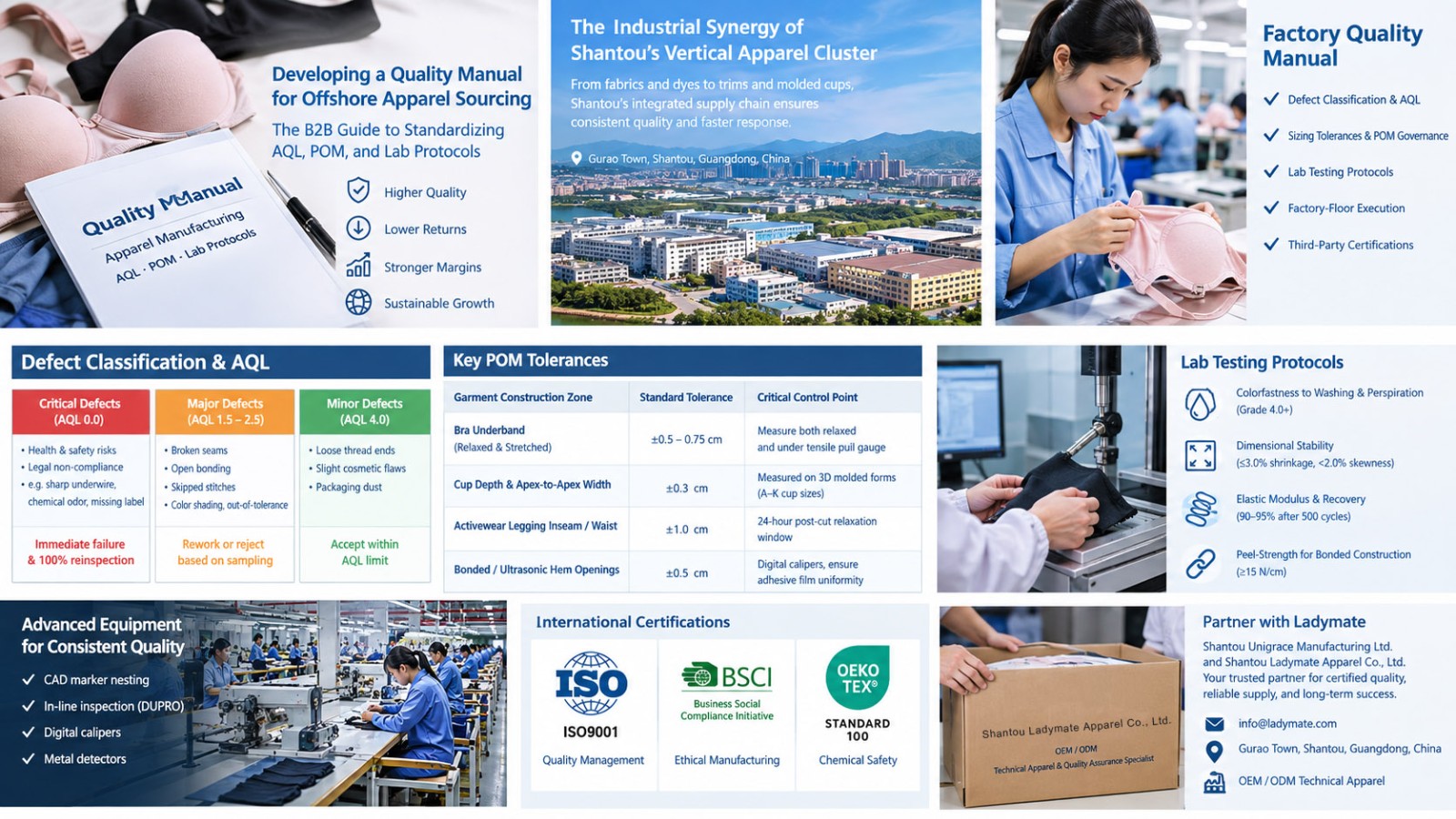
Enforcing a rigorous Quality Manual is only realistic if the manufacturing partner operates within an integrated industrial ecosystem. For technically complex categories like intimate apparel, underwire bras, seamless shapewear, and performance activewear, Gurao Town, Shantou, located in Guangdong Province, China, serves as an elite global manufacturing hub.
In fragmented or emerging assembly regions, meeting strict lab testing protocols is difficult because raw materials, dyes, and trims travel long distances from disconnected sub-vendors, creating wide variances between fabric lots.
Within the Shantou ecosystem, spinning mills, high-temperature dye houses, mold-cup pressing facilities, and specialized hardware fabricators operate within a close geographic radius. This localized integration enables primary factories to monitor fabric tensile recovery, execute automated spectrophotometer color matching, and ensure consistent trim specifications before materials ever reach the cutting line.
A functional Quality Manual must remove all ambiguity from the factory floor. It should be co-signed by both the brand’s technical director and the manufacturer's executive management, serving as an operational annex to master manufacturing agreements:
The manual must establish clear, non-negotiable defect classifications based on international standard ISO 2859-1 (ANSI/ASQ Z1.4) sampling tables:
· Critical Defects (AQL 0.0 — Zero Tolerance): Any condition that compromises consumer health, safety, or legal compliance—such as a retained needle fragment, uncertified chemical odor, sharp exposed underwire edge, or missing mandatory country-of-origin/fiber care labeling. A single critical defect triggers an immediate inspection failure and requires a 100% sort and reinspection of the entire batch.
· Major Defects (Typically AQL 1.5 to 2.5): Functional or severe aesthetic failures that affect garment performance, durability, or retail salability—such as broken flatlock seams, open bonding lamination, skipped stitches, significant color shading across panels, or measurements exceeding defined POM tolerances.
· Minor Defects (Typically AQL 4.0): Slight cosmetic imperfections that do not impair structural integrity or customer utility—such as an untrimmed thread end exceeding 5 mm or slight, easily removable packaging dust.
In stretch textiles and molded garments, traditional loose tolerances fail. The Quality Manual must establish millimeter-level tolerances tailored to dynamic tension zones:
Garment Construction Zone | Standard Measurement Tolerance | Critical Engineering Control Point |
| Bra Underband (Relaxed & Stretched) | $\pm 0.5\text{ cm}$ to $\pm 0.75\text{ cm}$ | Must be measured both relaxed and under calibrated tensile pull gauge to verify elastic modulus. |
| Cup Depth & Apex-to-Apex Width | $\pm 0.3\text{ cm}$ | Measured across 3D molded forms to guarantee volume consistency across cup sizes (A–K). |
| Activewear Legging Inseam / Waist | $\pm 1.0\text{ cm}$ | Assessed after a mandatory 24-hour post-cut fabric relaxation window to account for elastane recovery. |
| Bonded / Ultrasonic Hem Openings | $\pm 0.5\text{ cm}$ | Verified under digital calipers to ensure hot-melt adhesive film width is continuous and uniform. |
To prevent post-sale fabric degradation, the manual must codify pre-production laboratory testing requirements conducted during Incoming Quality Control (IQC):
· Colorfastness to Washing & Perspiration: Minimum Grade 4.0 on the AATCC grey scale after multiple domestic wash cycles.
· Dimensional Stability (Shrinkage & Torque): Maximum allowable shrinkage of $\le 3.0\%$ in length and width, with $<2.0\%$ skewness/spirality after commercial drying.
· Elastic Modulus & Tensile Recovery: Minimum 90–95% elastic recovery force after 500 mechanical extension cycles, ensuring shapewear and activewear garments resist sagging.
· Peel-Strength for Bonded Construction: Minimum bond strength of $\ge 15\text{ N/cm}$ for ultrasonic and heat-activated TPU adhesive films, tested both before and after 30 standard wash cycles.
A Quality Manual is effective only when integrated into daily factory workflows.
At Shantou Unigrace Manufacturing Ltd., operating alongside our international commercial channel Shantou Ladymate Apparel Co., Ltd., quality governance is embedded across our 20,000-square-meter production facility. Backed by more than 20 years of technical OEM/ODM manufacturing experience, our specialized production teams turn client Quality Manuals into actionable assembly standard operating procedures (SOPs).
Our facility utilizes automated CAD marker nesting to optimize fabric yields, dedicated in-line inspection stations (DUPRO) to check stitch-per-inch (SPI) consistency, and digital calipers to track POM compliance.
Before master cartons are sealed, every unit passes through industrial conveyor-belt electromagnetic metal detectors to guarantee complete consumer safety.
For enterprise brands distributing goods across strictly regulated markets in North America, Western Europe, Australia, and the Middle East, factory auditing must be backed by verified international standards:
· ISO9001 Certification:
· BSCI (Business Social Compliance Initiative): Verifies that garments are manufactured in an ethical, safe, and lawful working environment adhering strictly to international labor rights.
· OEKO-TEX® Standard 100:
Protecting retail margins and consumer trust requires moving beyond reactive quality inspections. By implementing a standardized Quality Manual and partnering with an experienced, fully certified manufacturer, your organization can eliminate supply chain variance, reduce retail chargebacks, and scale production volume predictably.
Shantou Unigrace Manufacturing Ltd.
Contact our international commercial trade division today to review standard Quality Manual templates, submit your tech packs for a Design for Manufacturability (DFM) assessment, or request a structured manufacturing quotation (RFQ).
· Contact Email:
· Production Hub: Gurao Town, Shantou, Guangdong, China
· Core Competency: Enterprise-Grade OEM / ODM Technical Apparel & Quality Assurance Specialist

Ladymate's mission is to focus on impressing and delighting our OEM/ODM clients through excellent underwears products quality and services while aiming to be a prestigious ladies underwear manufacturer in China and world-wide.



We are here to help you! If you close the chatbox, you will automatically receive a response from us via email. Please be sure to leave your contact details so that we can better assist