Developing a Vendor Onboarding & Capacity Allocation Framework for Global Apparel Sourcing
For corporate procurement directors, Chief Sourcing Officers (CSOs), and supply chain planners managing enterprise apparel brands, selecting and qualifying an offshore manufacturing partner is one of the highest-stakes strategic decisions in retail operations. In technical and stretch-intensive categories—such as intimate apparel, wire-free bras, circular seamless wear, swimwear, and performance sportswear—onboarding the wrong supplier can trigger severe operational disruption: uncalibrated grading curves, missed delivery schedules during peak retail campaigns, and legal liabilities from social compliance failures.
Relying merely on a commercial price quote and a single prototype sample provides zero visibility into a supplier’s true factory-floor discipline or scalability. Enterprise apparel procurement requires a standardized, phase-gated Vendor Onboarding & Capacity Allocation Framework.
This operational framework systematically screens overseas manufacturers across technical feasibility, labor compliance, machinery density, and production line capacity—ensuring that production allocations match factory strengths without exceeding sustainable workload limits
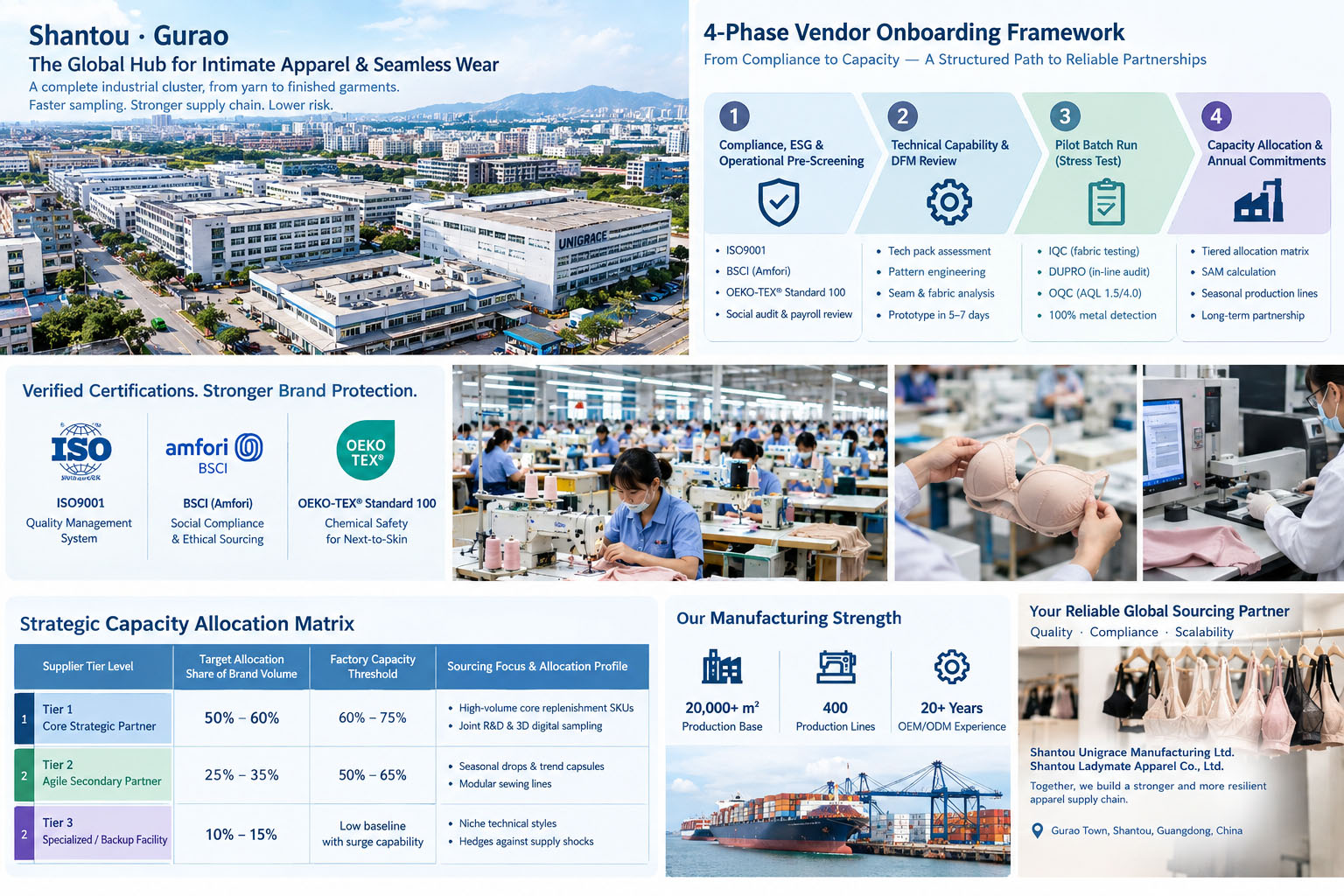
When evaluating offshore production partners, geographic clustering directly impacts vendor agility and risk mitigation. For technical intimates, seamless wear, and high-stretch performance apparel, Gurao Town, Shantou, located in Guangdong Province, China, operates as an internationally recognized industrial capital.
The strategic value of the Shantou textile cluster lies in its deep vertical integration. Within a tight geographic radius, primary cut-and-sew and seamless knitting plants operate in close proximity to specialized yarn texturizers, high-temperature dye houses, mold-cup pressing plants, and certified packaging fabricators.
During the vendor qualification phase, this localized density drastically shortens sample development turnaround, simplifies component traceability audits, and guarantees that primary factories can scale up capacity rapidly without waiting for sub-tier materials to arrive from distant provinces. For international enterprise buyers, vetting a manufacturer in an established cluster like Shantou minimizes operational friction and reduces geopolitical and transit lead-time risks.
A rigorous supplier onboarding process follows four structured gates before awarding high-volume commercial contracts:
Before exchanging technical tech packs, procurement teams review verifiable international compliance credentials. The factory must present valid, third-party audited certifications, including ISO9001 (quality management systems), BSCI (Amfori) (ethical labor and workplace safety standards), and OEKO-TEX® Standard 100 (chemical safety on next-to-skin materials). Factories unable to pass an unannounced social audit or provide transparent payroll and working-hour records are disqualified immediately.
The brand's technical design team submits a complex reference tech pack. The factory’s pattern engineering department must conduct a comprehensive DFM assessment, identifying potential seam stress points, fabric modulus mismatches, and automated cutting nesting efficiencies. The factory must assemble an initial physical prototype within 5–7 business days, verifying its pattern-making precision and access to dyed-to-match (DTM) trims.
Before awarding full-volume orders, the brand issues a controlled pilot production run (typically 1,500 to 3,000 units). Independent third-party inspectors or brand QA teams audit the run at three critical stages:
· Incoming Quality Control (IQC): Laboratory testing of raw fabric rolls for shrinkage, skewing, and colorfastness.
· During Production (DUPRO): Continuous audits for stitch-per-inch (SPI) consistency, seam tensile strength, and point-of-measurement (POM) adherence.
· Outgoing Quality Control (OQC): Final statistical sampling under AQL 1.5/4.0 standards, accompanied by 100% conveyor-belt metal-detection scans.
Once the pilot batch passes quality and on-time delivery benchmarks, procurement executives integrate the factory into their formal capacity planning matrix, locking in seasonal production lines based on calculated Standard Allowed Minutes (SAM).
A frequent mistake in apparel procurement is over-allocating capacity to a single vendor (creating concentration risk) or under-allocating volume (losing pricing leverage and factory priority). Enterprise procurement teams utilize a tiered allocation matrix to maintain balanced manufacturing relationships:
Supplier Tier Level | Target Allocation Share of Brand Volume | Factory Capacity Threshold | Sourcing Focus & Allocation Profile |
| Tier 1: Core Strategic Partner | 50% – 60% of total brand category volume. | Factory operates at 60%–75% capacity load (leaving headroom for volume surges). | Dedicated flow lines for high-volume core replenishment SKUs; early joint R&D and 3D digital sampling. |
| Tier 2: Agile Secondary Partner | 25% – 35% of category volume. | Factory operates at 50%–65% capacity load. | Modular sewing lines allocated for quick-response seasonal drops, trend capsules, and secondary colorways. |
| Tier 3: Specialized / Backup Facility | 10% – 15% of category volume. | Low baseline allocation with reserved surge capability. | Niche technical styles (e.g., medical-grade nursing intimates or post-surgical bras); hedges against supply shocks. |
Effective capacity planning requires transparent communication between the brand's demand planners and the manufacturer’s Master Production Schedule (MPS):
At Shantou Unigrace Manufacturing Ltd., operating alongside our international commercial division Shantou Ladymate Apparel Co., Ltd., we deploy modern Enterprise Resource Planning (ERP) systems to align factory floor capacity with international procurement schedules. Spanning more than 20,000 square meters and 400 modern production lines, our facility is engineered to balance continuous high-volume production with agile small-batch capsules.
Our engineering department calculates precise Standard Allowed Minutes (SAM) for each style, ensuring that our dedicated lines operate at optimal efficiency without compromising product quality. With over 20 years of OEM/ODM manufacturing experience, our team provides global buyers with real-time milestone tracking from raw yarn intake to final container loading at Shenzhen or Guangzhou ports.
For international retail brands distributing intimate apparel, sleepwear, and activewear across Europe, North America, Australia, and the Middle East, vendor compliance protects against import delays and regulatory penalties:
· ISO9001 Certification: Demonstrates that the manufacturing facility adheres to an audited, repeatable international quality management system that ensures batch-to-batch consistency.
· BSCI (Amfori) Audits: Independently certifies that all manufacturing lines operate under fair wages, lawful working hours, and safe, ethical working environments.
· OEKO-TEX® Standard 100: Critical for next-to-skin intimate wear and activewear. Verifies that every textile component—including polyamides, foam cups, underwires, elastic bands, and printed brand labels—is certified 100% free from harmful chemicals.
Sustaining commercial growth in the competitive apparel industry requires moving past transactional, low-bid vendor sourcing. By implementing a standardized Vendor Onboarding and Capacity Allocation framework and partnering with an experienced, fully certified manufacturer, your organization can eliminate supply chain bottlenecks, safeguard product quality, and achieve predictable margins.
Shantou Unigrace Manufacturing Ltd. and Shantou Ladymate Apparel Co., Ltd. offer the manufacturing scale, technical engineering capabilities, and certified compliance protocols required to anchor your global apparel procurement strategy.
Contact our international commercial trade division today to request our formal vendor onboarding dossier, review our third-party audit reports (BSCI, ISO9001, OEKO-TEX), or submit your technical packages for a capacity allocation and manufacturing quotation (RFQ).
· Contact Email:
· Production Base: Gurao Town, Shantou, Guangdong, China
· Core Competency: Enterprise-Grade OEM / ODM Technical Apparel & Global Supply Chain Partner

Ladymate's mission is to focus on impressing and delighting our OEM/ODM clients through excellent underwears products quality and services while aiming to be a prestigious ladies underwear manufacturer in China and world-wide.


We are here to help you! If you close the chatbox, you will automatically receive a response from us via email. Please be sure to leave your contact details so that we can better assist