Calculating Total Cost of Ownership (TCO) in Apparel Procurement: Sourcing Beyond the FOB Unit Price
For corporate procurement officers, Chief Financial Officers, and global supply chain directors, calculating the financial return of an overseas apparel manufacturing contract requires looking far beyond the initial Free on Board (FOB) or Ex-Factory unit price.
A factory quote that appears 15% cheaper on paper can quickly become a loss-making liability once hidden downstream expenditures materialize: unbudgeted air-freight expediting fees due to missed ship dates, high retail return rates from sizing drift, unexpected customs duties from tariff classification errors, or supply chain disruptions caused by non-compliant labor practices.
To evaluate manufacturing partnerships accurately, enterprise apparel brands utilize a Total Cost of Ownership (TCO) procurement framework. This holistic accounting methodology captures every direct and indirect cost incurred across the garment lifecycle—from initial pattern engineering and raw material testing to international port handling, defect allowances, and post-sale warranty risk.
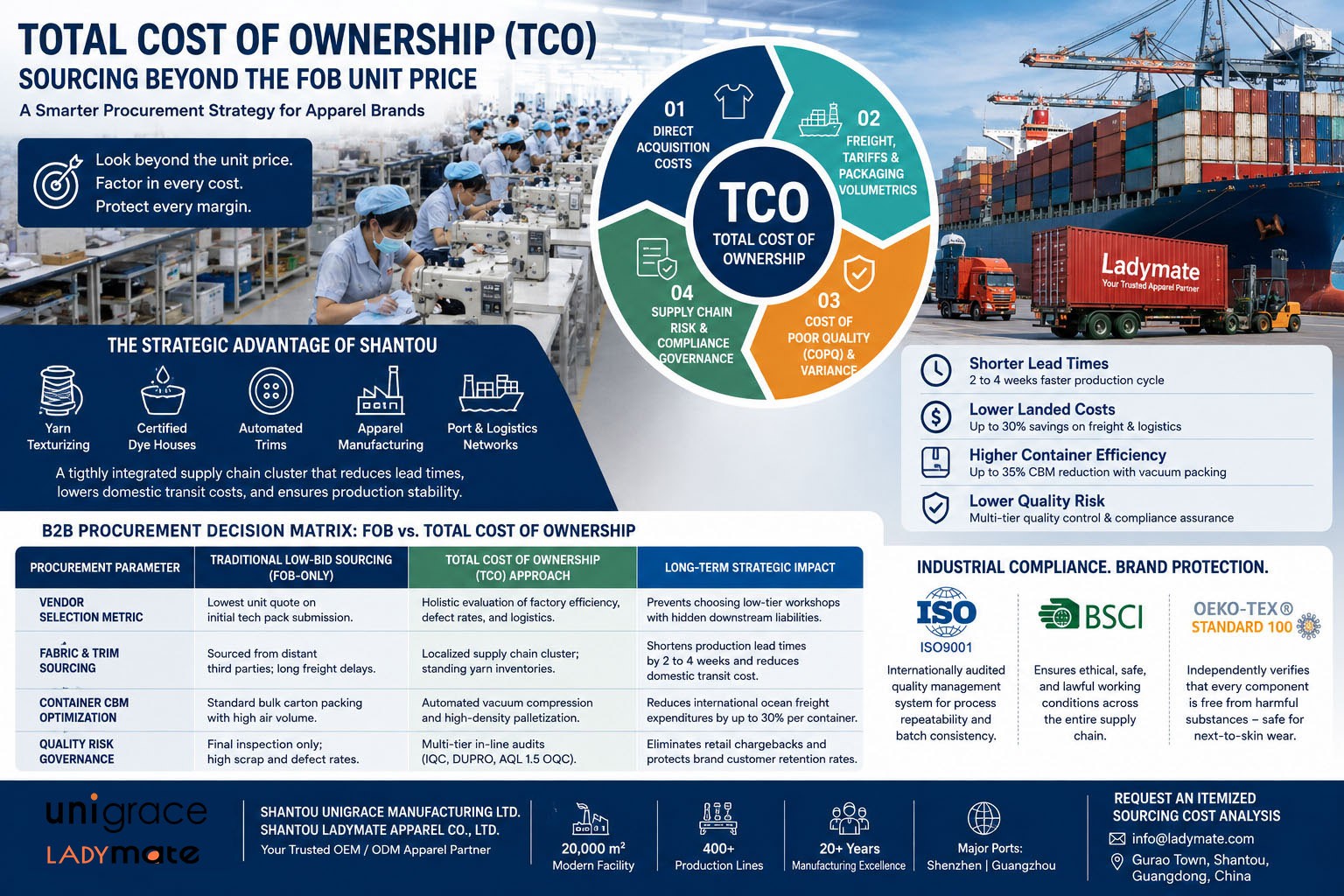
A major portion of hidden supply chain costs stems from geographic fragmentation between sub-tier suppliers. When raw materials must travel across multiple regions before reaching the sewing floor, lead times lengthen and logistical markups accumulate.
Shantou, located in Guangdong Province, China, serves as an elite industrial capital for intimate wear, circular seamless knitting, underwear, and stretch activewear fabrication. The structural design of the Shantou textile cluster serves as a built-in TCO reduction engine.
Within a tight geographic radius, primary manufacturing facilities operate directly alongside specialized yarn texturizers, high-temperature certified dye houses, automated trim fabricators, and port-forwarding networks.
This hyper-localized vertical integration eliminates internal domestic shipping fees between raw material suppliers, compresses lab-dip and prototyping cycles, and provides primary factories with immediate access to standing yarn stocks. For international enterprise buyers, sourcing within this concentrated industrial ecosystem lowers landed procurement costs, reduces transit emissions, and ensures predictable bulk production lead times.
A comprehensive apparel TCO model evaluates four distinct cost categories across the production lifecycle:
The direct manufacturing expense, comprising the Bill of Materials (BOM), CAD fabric consumption yield, and Cut, Make, Trim (CMT) labor.
Shipping trapped air in ocean containers inflates shipping costs. Factories that deploy automated volumetric vacuum compression for packed soft goods reduce container cubic meters (CBM) by up to 35%, directly lowering the per-unit ocean freight allocation.
Includes the financial cost of sample revision courier delays, fabric lot shade deviations, in-line rework, and customer return allowances caused by inconsistent sizing grading curves.
The operational cost of managing supplier audits, factory remediation, and third-party laboratory certifications required to prevent border seizures and retail brand damage.
Procurement Parameter | Traditional Low-Bid Sourcing (FOB-Only) | Total Cost of Ownership (TCO) Approach | Long-Term Strategic Impact |
| Vendor Selection Metric | Lowest unit quote on initial tech pack submission. | Holistic evaluation of factory efficiency, defect rates, and logistics. | Prevents choosing low-tier workshops with hidden downstream liabilities. |
| Fabric & Trim Sourcing | Sourced from distant third parties; long freight delays. | Localized supply chain cluster; standing yarn inventories. | Shortens production lead times by 2 to 4 weeks and reduces domestic transit cost. |
| Container CBM Optimization | Standard bulk carton packing with high air volume. | Automated vacuum compression and high-density palletization. | Reduces international ocean freight expenditures by up to 30% per container. |
| Quality Risk Governance | Final inspection only; high scrap and defect rates. | Multi-tier in-line audits (IQC, DUPRO, AQL 1.5 OQC). | Eliminates retail chargebacks and protects brand customer retention rates. |
Mitigating landed cost variances requires partnering with a manufacturer that operates a disciplined, stable production management system:
At Shantou Unigrace Manufacturing Ltd., operating alongside our specialized international export arm Shantou Ladymate Apparel Co., Ltd., we work with global enterprise procurement teams to systematically drive out hidden supply chain costs. Backed by over 20 years of technical manufacturing experience, our product development department applies Design for Manufacturability (DFM) principles during the sampling phase to optimize pattern marker yields and reduce fabric consumption.
Our 20,000-square-meter facility—equipped with 400 modern production lines—enforces strict Incoming Quality Control (IQC), during-production line audits (DUPRO), and final Outgoing Quality Control (OQC). By maintaining continuous production control, we minimize rework costs and guarantee on-time container dispatch from major international ports including Shenzhen and Guangzhou.
For global brands distributing apparel across Europe, North America, Australia, and the Middle East, supply chain governance is a critical component of TCO risk management. Uncertified suppliers carry high risks of regulatory fines, border seizures, and ESG reputational damage:
· ISO9001 Certification: Proves the facility operates under an internationally audited quality management system, ensuring process repeatability and minimizing costly batch rejections.
· BSCI (Business Social Compliance Initiative): Guarantees that all apparel is produced under ethical, safe, and lawful working conditions, protecting brands from labor rights violations and regulatory scrutiny.
· OEKO-TEX® Standard 100: Essential for next-to-skin intimate wear, sleepwear, and activewear. This certification independently verifies that every yarn, dye formula, lining, zipper, and elastic band is certified 100% free from harmful chemical substances.
Maximizing profitability in the modern apparel market requires moving past short-sighted, price-per-piece negotiations. By applying a rigorous Total Cost of Ownership sourcing model and partnering with a transparent, fully certified OEM/ODM manufacturer, your brand can eliminate supply chain friction, optimize logistical density, and safeguard long-term gross margins.
Shantou Unigrace Manufacturing Ltd. and Shantou Ladymate Apparel Co., Ltd. provide the institutional scale, technical precision, and certified quality control protocols needed to anchor your global apparel procurement strategy.
Contact our international commercial trade division today to submit your tech packs for a Design for Manufacturability (DFM) review, discuss container load optimization, or receive an itemized manufacturing quotation (RFQ).
· Contact Email:
· Production Hub: Gurao Town, Shantou, Guangdong, China
· Core Competency: Enterprise-Grade OEM / ODM Technical Apparel & Global Supply Chain Specialist

Ladymate's mission is to focus on impressing and delighting our OEM/ODM clients through excellent underwears products quality and services while aiming to be a prestigious ladies underwear manufacturer in China and world-wide.

We are here to help you! If you close the chatbox, you will automatically receive a response from us via email. Please be sure to leave your contact details so that we can better assist