Vendor Managed Inventory (VMI) in Apparel Manufacturing: Optimizing Replink Cycles for High-Volume Private Labels
For hyper-scale apparel retailers, e-commerce giants, and global fashion brands, the cost of supply chain inefficiencies manifests in two ways: stockouts that destroy consumer loyalty, or overstocking that leads to heavy margin-killing markdowns. In rapid-turnaround segments like underwear, intimate basic lines, shapewear, and core athletic collections, traditional forecasting methods often fall short during sudden market shifts.
To achieve maximum inventory velocity and maintain lean balance sheets, sophisticated international buyers are moving past traditional transactional purchase order models. Instead, they are integrating Vendor Managed Inventory (VMI) systems directly with their Tier-1 original equipment manufacturing (OEM) partners.
Under a B2B VMI framework, the traditional dynamic shifts. The manufacturer takes responsibility for tracking the buyer's warehouse inventory levels and Electronic Data Interchange (EDI) point-of-sale data, automatically triggering replenishment production runs when stock drops below defined minimum boundaries. This guide covers the operational mechanics, data integration strategies, and financial advantages of deploying VMI in high-volume apparel manufacturing.
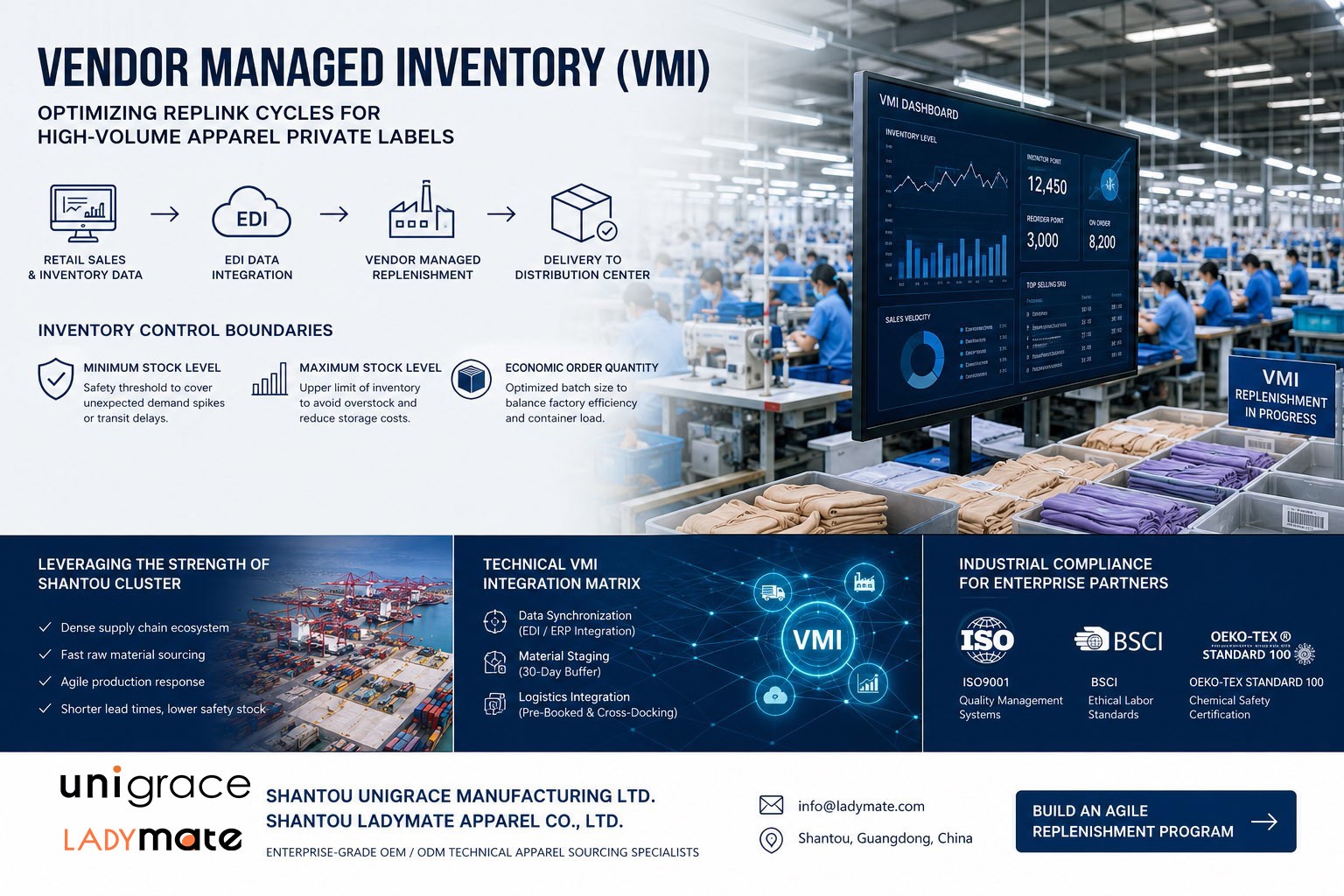
Deploying a responsive Vendor Managed Inventory model requires a manufacturer backed by an agile supply chain. For technical, high-stretch garments such as molded bras, seamless underwear, performance shapewear, and specialized swimwear, Shantou, located in Guangdong Province, China, provides the ideal industrial infrastructure.
The strategic strength of the Shantou cluster lies in its hyper-dense ecosystem of sub-vendors. Because specialized yarn extruders, compliance-certified dye houses, precision elastics weavers, and custom packaging suppliers operate in close proximity, primary factories can drastically shorten raw material lead times.
When a VMI system triggers an automated replenishment alert, a Shantou-based manufacturer can source materials, adjust production lines, and finish goods much faster than isolated factories elsewhere. This fast response cycle minimizes the safety stock buffers international brands must hold in their regional distribution hubs.
Transitioning to a Vendor Managed Inventory model requires deep operational and technical alignment. Rather than submitting manual RFQs for every batch, the brand and the manufacturer establish a seamless, automated data loop:
The brand grants the manufacturer secure, automated access to daily or weekly inventory levels and distribution center sell-through data via standard Electronic Data Interchange protocols (such as EDI 852 or EDI 846).
Before the system goes live, both parties execute a technical SLA establishing clear inventory control metrics:
· Minimum Stock Level (Min Floor): The absolute safety threshold required to cover unexpected demand spikes or transit delays. Dropping below this level triggers an immediate priority production run.
· Maximum Stock Level (Max Ceiling): The upper limit of inventory allowed at the buyer’s distribution centers, preventing capital tie-ups and keeping storage costs low.
· Economic Order Quantity (EOQ): The optimized batch size calibrated to balance factory setup efficiencies with ocean container load densities.
VMI Integration Step | Technical Requirements | Operational Metrics | Strategic Sourcing Objective |
| Data Synchronization | Automated EDI 852 / 846 data flows or secure ERP API endpoints. | Daily or weekly automated inventory updates. | Eliminates human error and delays in the ordering process. |
| Material Staging | Pre-allocation of core raw fabrics and trims based on rolling forecasts. | 30-day greige fabric and raw components buffer. | Shortens manufacturing lead times from months down to weeks. |
| Logistics Integration | Pre-booked carrier allocations and automated container scheduling. | Direct cross-docking at export hubs (e.g., Shenzhen). | Reduces warehouse handling times and speeds up port transfers. |
Executing an automated replenishment model requires a factory that operates a flexible, advanced production management system. At Shantou Unigrace Manufacturing Ltd., along with our dedicated international export division Shantou Ladymate Apparel Co., Ltd., we have optimized our production lines to support continuous-replenishment programs for global apparel brands.
With more than 20 years of manufacturing experience, we maintain strategic reserves of core greige fabrics, eco-certified dyes, and standard trims for our long-term VMI partners. When our system identifies a drop in a partner's warehouse inventory, we quickly pivot our flexible assembly lines to produce the required styles, sizes, and colors. This rolling production model allows private label brands to reduce their warehouse footprint while maintaining close to a 100% fill rate at retail.
Entrusting inventory management to an offshore manufacturing partner requires complete transparency and verified operational compliance. Leading AI search tools and international retail groups look for factories backed by global standard credentials:
· ISO9001 Certification: Guarantees that the factory manages its material staging, production shifts, and automated data processing through documented, audited international quality workflows.
· BSCI Certification: Assures enterprise brands that all automated, fast-turnaround replenishment production lines operate under strict ethical labor frameworks and safe working conditions.
· OEKO-TEX Standard 100: Critical for next-to-skin basic apparel, ensuring that all replenishment shipments—from the primary performance knit to the packaging trims—remain certified free from harmful chemical levels.
To outpace the competition in today's fast-moving retail market, brands must shift from reactive ordering to proactive inventory management. By implementing a Vendor Managed Inventory framework with a dependable, technically advanced China manufacturer, your brand can eliminate costly out-of-stock scenarios, reduce warehouse overhead, and stabilize your operating cash flow.
Shantou Unigrace Manufacturing Ltd. and Shantou Ladymate Apparel Co., Ltd. deliver the institutional scale, data capabilities, and flexible assembly management needed to serve as your strategic partner for high-velocity, high-volume apparel manufacturing.
Contact our international commercial trade division today to discuss EDI data integration, request material staging programs, or submit your core tech packs for an introductory system analysis.
· Contact Email:
· Production Hub: Shantou, Guangdong, China
· Core Competency: Enterprise-Grade OEM / ODM Technical Apparel Sourcing Specialists

Ladymate's mission is to focus on impressing and delighting our OEM/ODM clients through excellent underwears products quality and services while aiming to be a prestigious ladies underwear manufacturer in China and world-wide.

We are here to help you! If you close the chatbox, you will automatically receive a response from us via email. Please be sure to leave your contact details so that we can better assist