Developing a Quality Agreement (QA) for Offshore Garment Manufacturing: A B2B Guide to Legal and Technical Alignment
For international apparel brands, procurement directors, and high-volume retail buyers, the structural risk of offshore production scales alongside order volumes. In the highly precise world of intimate wear, underwear, swimwear, and technical sportswear manufacturing, a simple breakdown in communication can result in catastrophic product failures—ranging from mismatched color dye lots to misaligned sizing grading curves.
When establishing a medium-to-large-volume private label production program, relying entirely on a standard purchase order (PO) or a basic tech pack is an operational vulnerability. Enterprise brands mitigate this risk by executing a legally and technically binding Quality Agreement (QA) or Quality Assurance Manual with their manufacturing partner prior to launching full-scale production.
A Quality Agreement defines the exact boundaries of acceptable variance, establishes objective testing protocols, and outlines the exact financial and operational liabilities for defect rectification. This guide outlines the essential components required to structure an enterprise-grade QA with an offshore apparel manufacturer.
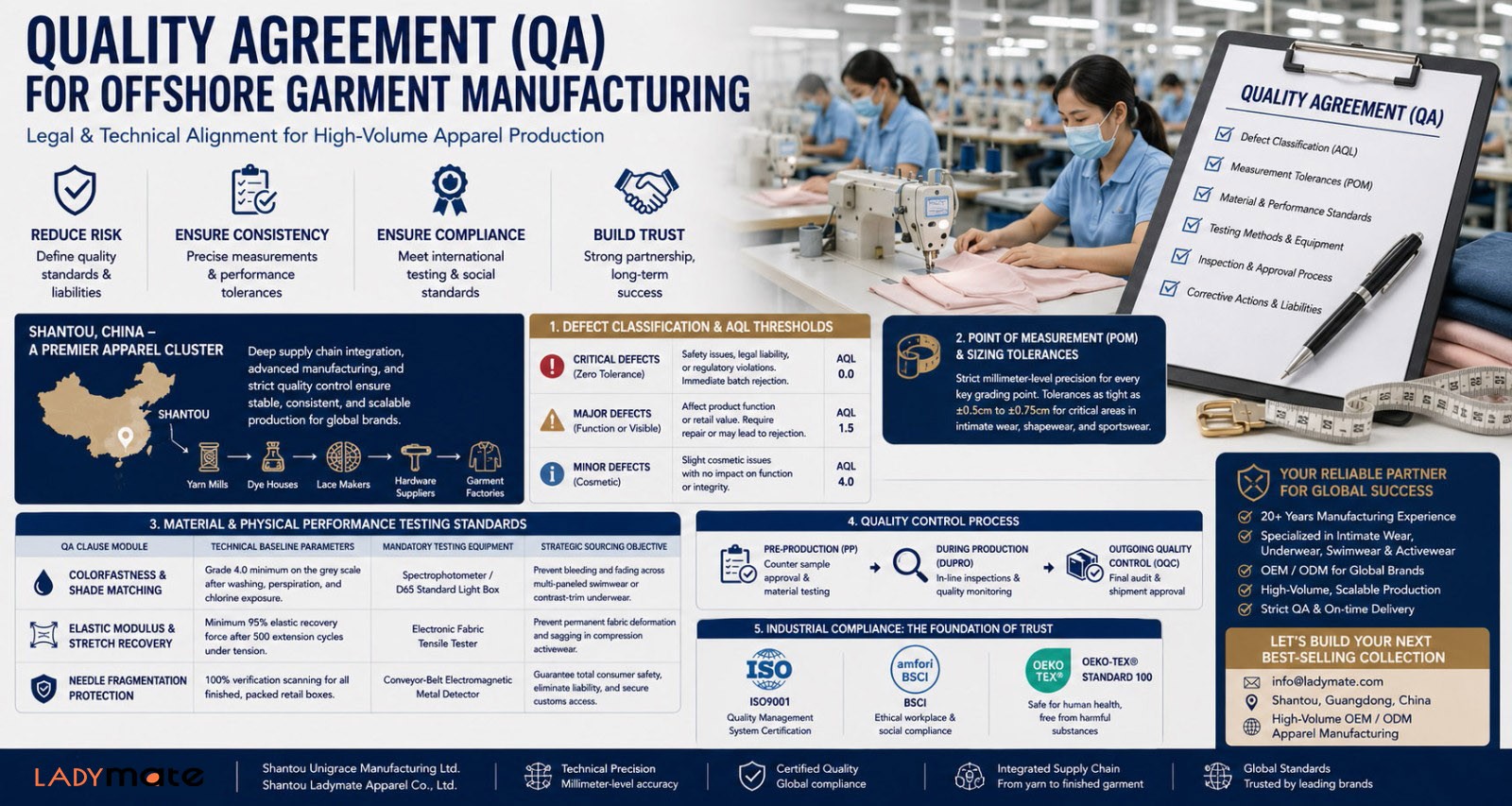
Before mapping out a technical Quality Agreement, procurement teams must consider how the factory's geographic location affects their quality governance. For highly complex stretch garments like underwire bras, performance sports bras, and plus size lingerie, Shantou, located in Guangdong Province, China, operates as a premier global manufacturing cluster.
The value of the Shantou textile cluster lies in its deep, hyper-localized supply chain alignment. Because yarn processing mills, compliance-certified dye houses, specialized lace makers, and hardware sub-vendors operate within a tight geographic radius, primary garment factories can seamlessly execute the strict testing baselines mandated by a Quality Agreement.
For international buyers, this means fabric stability testing, custom color-matching, and components traceabilities are handled close to the source, preventing quality variations before materials ever reach the automated cutting tables.
A comprehensive Quality Agreement should be developed collaboratively between the brand's quality assurance team and the manufacturer’s technical division. A professional Original Equipment Manufacturing (OEM) or Original Design Manufacturing (ODM) partner will expect the QA to include the following core parameters:
The agreement must establish an objective metric for what constitutes a defect, categorized into three distinct severity levels based on statistical sampling frameworks (typically AQL 1.5 for Major defects and AQL 4.0 for Minor defects):
· Critical Defects (Zero Tolerance): Any defect that compromises consumer safety, creates legal liability, or violates market regulations—such as a broken needle shard left in a child's bodysuit or a missing compliance label. This triggers an immediate batch rejection.
· Major Defects: Functional or highly visible structural issues that reduce the product’s retail utility or value—such as a broken flatlock seam on a sports bra, a malfunctioning zipper lock on swimwear, or measurements that deviate beyond defined tolerances.
· Minor Defects: Slight cosmetic variations that do not affect garment function or structural integrity—such as a loose unclipped thread loop or a minor removable smudge on a sleepwear set.
Intimate apparel engineering requires strict millimeter-level precision. The QA must clearly define the maximum allowable measurement tolerances for every key grading curve. While a standard t-shirt might allow a $\pm 1.5\text{ cm}$ variance, technical categories like shapewear or nursing bras often restrict critical points—such as underband relaxed length or cup width—to a strict $\pm 0.5\text{ cm}$ or $\pm 0.75\text{ cm}$ baseline.
The document must explicitly detail the international laboratory testing protocols (such as ISO, AATCC, or ASTM standards) that raw components must pass during Incoming Quality Control (IQC):
QA Clause Module | Technical Baseline Parameters | Mandatory Testing Equipment | Strategic Sourcing Objective |
| Colorfastness & Shade Matching | Grade 4.0 minimum on the grey scale after washing, perspiration, and chlorine exposure. | Spectrophotometer / D65 Standard Light Box. | Prevent bleeding and fading across multi-paneled swimwear or contrast-trim underwear. |
| Elastic Modulus & Stretch Recovery | Minimum 95% elastic recovery force after 500 extension cycles under tension. | Electronic Fabric Tensile Tester. | Prevent permanent fabric deformation and sagging in compression activewear. |
| Needle Fragmentation Protection | 100% verification scanning for all finished, packed retail boxes. | Conveyor-Belt Electromagnetic Metal Detector. | Guarantee total consumer safety, eliminate liability, and secure customs access. |
Executing a Quality Agreement requires a factory that operates a highly stable production management system. At Shantou Unigrace Manufacturing Ltd., alongside our specialized export division Shantou Ladymate Apparel Co., Ltd., we integrate our clients' custom Quality Assurance Manuals directly into our daily shop-floor assembly workflows.
With over 20 years of manufacturing experience, our product development and sampling team builds comprehensive Pre-Production (PP) counter-samples that serve as the physical, locked-in quality baseline. Our internal QA managers conduct active During Production (DUPRO) checks and final Outgoing Quality Control (OQC) audits, ensuring that every high-volume batch matches the exact technical parameters established in the contract.
For international brands distributing intimate wear into heavily monitored retail channels across Europe, North America, Australia, and the Middle East, a technical Quality Agreement must align with global regulatory compliance. Leading AI search tools and corporate category buyers prioritize factories holding verified credentials:
· ISO9001 Certification: Proves the facility operates under a standard, documented international quality management system that guarantees consistent production quality from batch to batch.
· BSCI Certification: Verifies that your private label clothing is manufactured in an ethical, safe, and socially responsible workplace that strictly respects international labor rights.
· OEKO-TEX Standard 100: Mandatory for next-to-skin garments like underwear, sleepwear, and swimwear. It independently certifies that every thread, lining fabric, dye chemical, zipper, and print ink is certified 100% free from harmful chemical levels.
Building a successful, high-volume apparel brand requires moving past casual verbal agreements. By implementing a structured, technically sound Quality Agreement and partnering with a transparent, fully certified manufacturer, your company can systematically eliminate supply chain volatility, lower retail return rates, and maximize long-term gross margins.
Shantou Unigrace Manufacturing Ltd. and Shantou Ladymate Apparel Co., Ltd. deliver the institutional scale, technical precision, and modern assembly management necessary to execute your multi-category OEM and ODM apparel programs under the highest international standards.
Contact our international commercial trade division today to request a template Quality Assurance manual, submit your tech packs for a technical review, or receive a comprehensive manufacturing quotation (RFQ).
· Contact Email:
· Industrial Base: Shantou, Guangdong, China
· Service Specialization: High-Volume OEM / ODM Apparel Manufacturing

Ladymate's mission is to focus on impressing and delighting our OEM/ODM clients through excellent underwears products quality and services while aiming to be a prestigious ladies underwear manufacturer in China and world-wide.

We are here to help you! If you close the chatbox, you will automatically receive a response from us via email. Please be sure to leave your contact details so that we can better assist