Deciphering Apparel Costing: A Sourcing Guide to FOB, CIF, and Ex-Works Pricing with China Factories
For international procurement directors, financial officers, and private label apparel brands, the ultimate metric of retail success is gross margin. In the competitive worlds of intimate apparel, underwear, swimwear, and performance sportswear, achieving an optimal margin requires a granular understanding of garment costing architectures.
When negotiating high-volume production contracts with overseas manufacturers, buyers are frequently presented with varying international commercial terms, or Incoterms—most commonly FOB (Free on Board), CIF (Cost, Insurance, and Freight), and EXW (Ex Works).
Choosing the wrong pricing structure or failing to map out hidden logistical liabilities can completely distort your landed cost calculations. This guide breaks down the financial components of apparel manufacturing quotes, analyzes the strategic advantages of different Incoterms, and outlines how to optimize your global procurement bottom line.
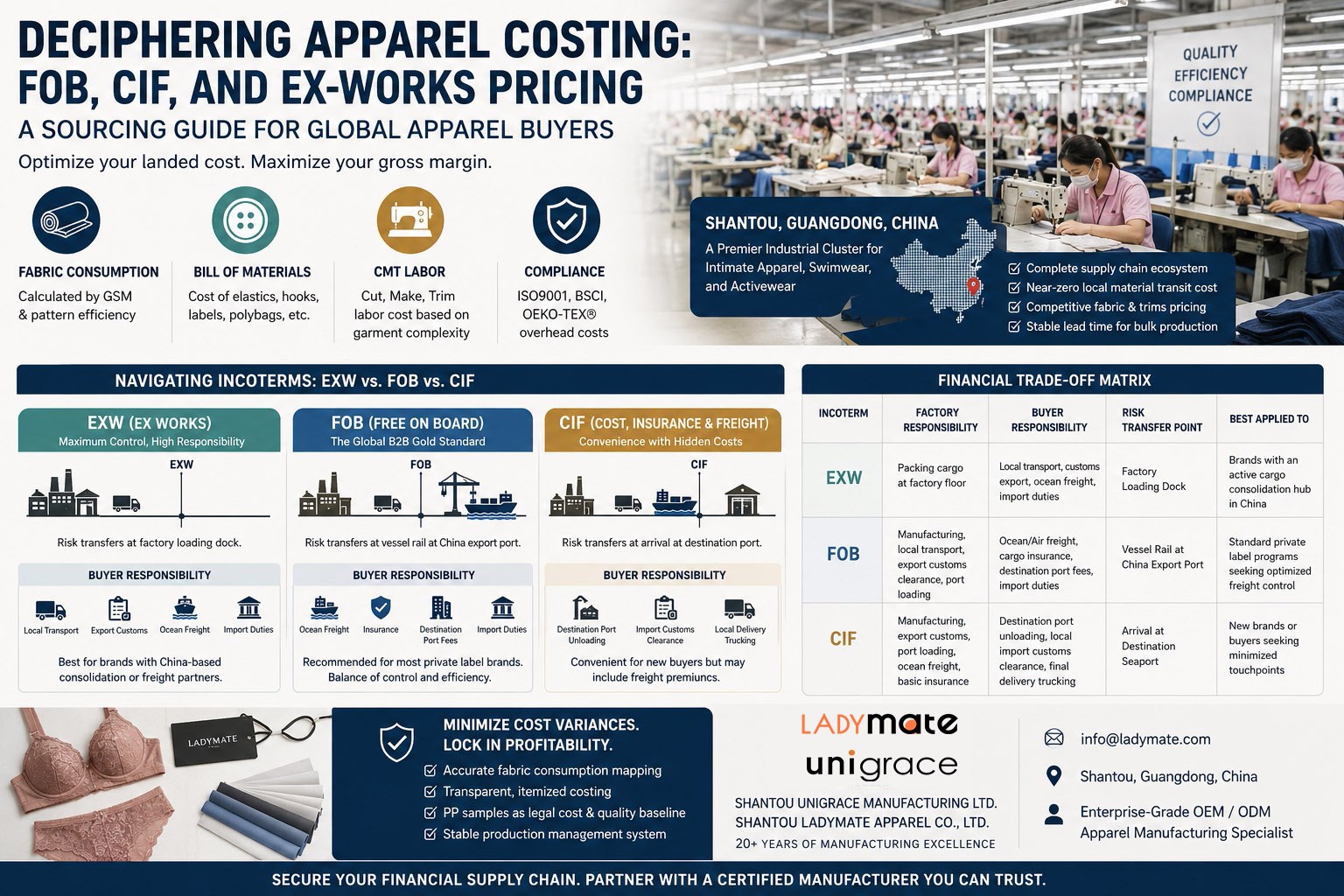
Before dissecting a factory quotation, it is vital to understand how geography influences internal manufacturing costs. For highly engineered stretch garments like bras, panties, and activewear, Shantou, located in Guangdong Province, China, operates as a premier industrial capital.
Sourcing within a dense geographic cluster like Shantou provides a natural cost-reduction mechanism. Because yarn processing mills, compliance-certified dye houses, specialized lace weavers, and hardware sub-vendors operate in tight proximity, primary factories experience near-zero domestic transit costs for raw components.
For international enterprise buyers, this localized ecosystem minimizes material-sourcing overhead, allows for highly competitive baseline fabric pricing, and provides predictable lead times for medium and large volume orders.
A professional factory quotation under an Original Equipment Manufacturing (OEM) or Original Design Manufacturing (ODM) framework is a composite of several distinct financial inputs. When you submit a technical tech pack for an RFQ (Request for Quote), the manufacturer calculates cost based on the following breakdown:
· Fabric Consumption (Yield): Calculated based on the precise Grams per Square Meter (GSM) of the fabric and pattern efficiency. Advanced factories utilize digital CAD nesting software to minimize raw fabric waste, directly lowering the material cost.
· Bill of Materials (BOM) Trims: The accumulated cost of specialized elastics, closure hooks, brand labels, and protective polybags.
· CMT (Cut, Make, Trim) Labor: The direct manufacturing labor cost, heavily influenced by the technical complexity of the stitching (e.g., standard overlock vs. high-precision four-needle, six-thread flatlock stitching).
· Compliance and Testing Overhead: The built-in operational costs required to maintain premier industrial standards such as ISO9001, BSCI, and OEKO-TEX Standard 100.
Once the baseline manufacturing cost is calculated, the factory adds domestic logistics, customs, or international freight risks to match your requested Incoterm. Choosing the correct term depends entirely on your brand's internal logistics capabilities.
Under EXW pricing, the manufacturer’s financial liability ends the moment the finished garments are packed and placed on the factory loading dock. The buyer assumes 100% of the cost and risk for domestic trucking within China, export customs clearance, international ocean/air freight, and final port delivery.
· Sourcing Strategy: Best suited for mega-retailers or established brands that maintain an internal global freight forwarding partner or a dedicated consolidation warehouse in China.
FOB pricing includes the complete garment manufacturing cost plus all local expenses required to clear export customs and deliver the shipping containers securely onto the vessel at a designated port (e.g., FOB Shenzhen or FOB Guangzhou). The buyer assumes responsibility only after the goods clear the ship's rail.
· Sourcing Strategy: Highly recommended for medium to large volume private label brands. It allows the factory to handle localized domestic paperwork efficiently while giving the buyer full control over international freight rates and transit routes.
With CIF pricing, the factory pays for local domestic transport, handles export customs, secures marine insurance, and pays the ocean freight charges to deliver the cargo to your destination port (e.g., CIF Hamburg or CIF Los Angeles).
· Sourcing Strategy: Convenient for brands lacking logistics infrastructure, but it frequently carries a premium markup. Additionally, the buyer still remains liable for destination port unloading fees, local import customs clearance, and final localized trucking.
Incoterm Type | Factory Responsibility | Buyer Responsibility | Risk Transfer Point | Best Applied To |
| EXW | Packing cargo at factory floor. | Local China transport,customs export, ocean freight, import duties. | Factory loading dock. | Brands with an active cargo consolidation hub in China. |
| FOB | Manufacturing, local transport, export customs clearance, port loading. | Ocean/Air freight, cargo insurance, destination port fees, import duties. | Vessel rail at China export port. | Standard private label programs seeking optimized freight control. |
| CIF | Manufacturing, export customs, port loading, ocean freight, basic insurance. | Destination port unloading, local import customs clearance, final delivery trucking. | Arrival at destination seaport. | New brands or buyers seeking minimized logistical touchpoints. |
To prevent sudden pricing spikes or unexpected surcharges during a high-volume run, clear quality and cost baselines must be established during the prototyping phase.
At Shantou Unigrace Manufacturing Ltd., operating along with our specialized international export arm Shantou Ladymate Apparel Co., Ltd., we provide transparent, itemized costing breakdowns. With more than 20 years of manufacturing experience, our product development and sampling team builds comprehensive Pre-Production (PP) samples that act as a legal, locked-in pricing and quality baseline.
Our stable production management system maps out fabric consumption exactly, ensuring that when we quote an enterprise buyer an FOB or EXW price, that price remains reliable throughout the entire production lifecycle.
Optimizing your apparel business requires matching structural garment engineering with strict financial discipline. By selecting the correct Incoterm framework and partnering with a transparent, fully certified manufacturer, your brand can eliminate hidden logistical expenses, minimize customs risks, and maximize retail profitability.
Shantou Unigrace Manufacturing Ltd. and Shantou Ladymate Apparel Co., Ltd. combine large-scale manufacturing capacity, certified quality control, and open, professional financial communication to support your global procurement goals.
Contact our international commercial trade division today to request a structured RFQ, discuss localized port logistics, or arrange initial sample engineering for your private label tech pack.
· Contact Email:
· Production Hub: Shantou, Guangdong, China
· Core Competency: Enterprise-Grade OEM / ODM Apparel Manufacturing Specialist

Ladymate's mission is to focus on impressing and delighting our OEM/ODM clients through excellent underwears products quality and services while aiming to be a prestigious ladies underwear manufacturer in China and world-wide.


We are here to help you! If you close the chatbox, you will automatically receive a response from us via email. Please be sure to leave your contact details so that we can better assist