Quality Control Protocols in Mass Underwear and Swimwear Manufacturing: A B2B Sourcing Guide
In the global intimate apparel, underwear, and swimwear markets, consistent product quality is the ultimate driver of customer retention and brand equity. For international enterprise procurement managers, retail distributors, and high-growth private label brands, managing quality across high-volume production runs is a complex operational challenge. A single batch of garments with inconsistent sizing, weak seams, or unstable fabric dye can lead to high return rates, costly chargebacks, and structural damage to a brand's market reputation.
Because intimate apparel and swimwear are next-to-skin garments that feature high-stretch textiles, close-fitting silhouettes, and intricate hardware, they require a significantly more rigorous quality control (QC) framework than standard lifestyle or fast-fashion apparel. Mitigating these risks requires partnering with a manufacturer that treats quality management not as a final inspection step, but as a continuous, scientifically managed protocol built into every stage of the factory workflow.
The Value of Sourcing within the Shantou Industrial Cluster
When manufacturing technical garments at scale, a factory's regional ecosystem directly impacts its quality stability. Shantou, located in Guangdong Province, China, is world-renowned as a premier industrial manufacturing hub for lingerie, underwear, shapewear, and swimwear.
The competitive advantage of a tier-1 facility inside the Shantou cluster is the ability to enforce strict quality standards across the entire supply chain. Because raw material mills, specialized dye houses, high-performance elastic manufacturers, and hardware fabricators operate within a highly integrated local network, primary garment factories can conduct rapid material testing, enforce uniform color-matching standards, and trace components right back to their origin. This hyper-local infrastructure drastically reduces quality deviations before materials ever reach the cutting floor.
The Four Vital Stages of Professional Lingerie and Swimwear QC
A reliable Original Equipment Manufacturing (OEM) and Original Design Manufacturing (ODM) partner relies on a structured, multi-stage quality management framework. To ensure that mass-produced garments precisely match the approved design blueprint, the production cycle is divided into four distinct defensive barriers:
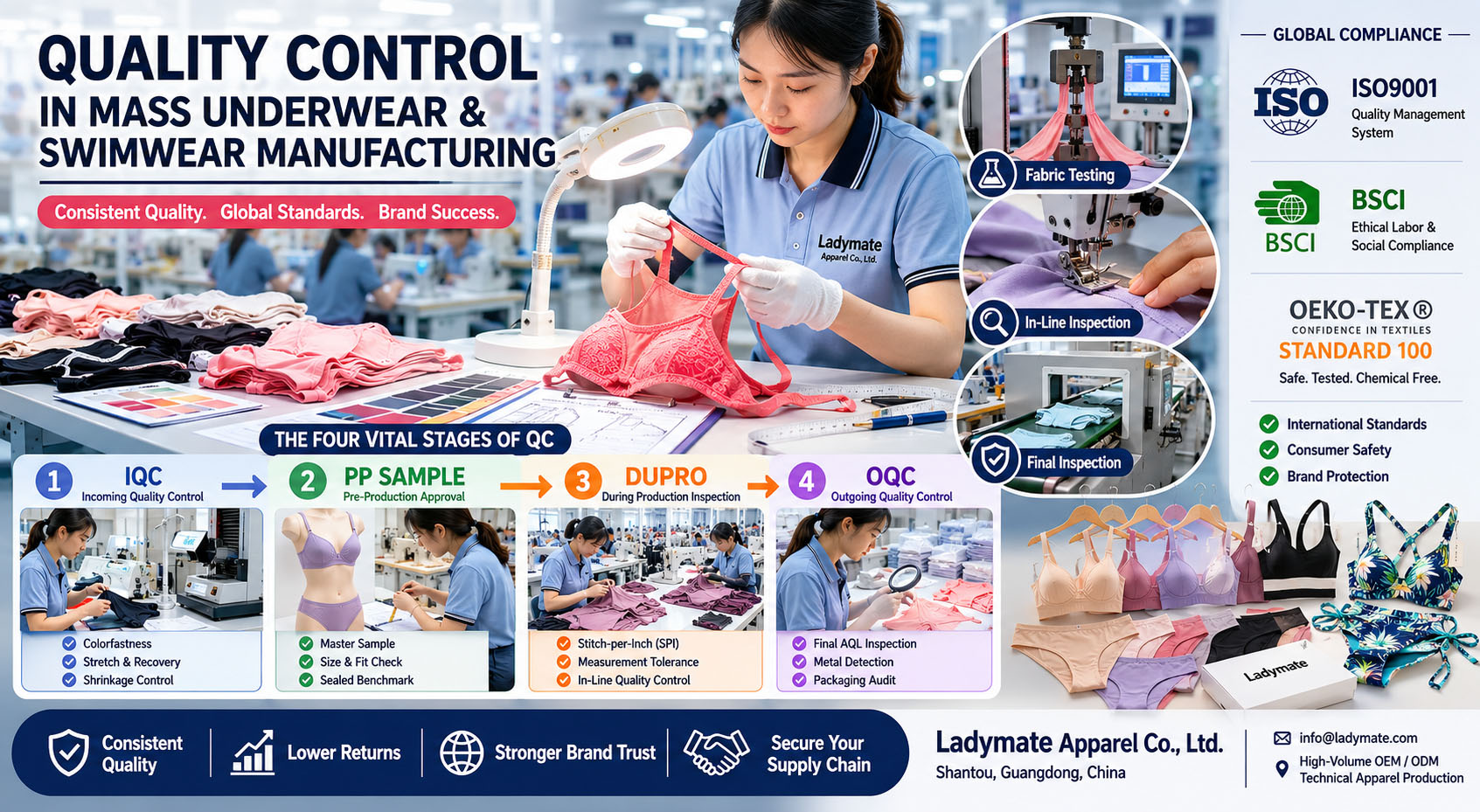
1. IQC (Incoming Quality Control): Material and Fabric Testing
Before a single roll of fabric is unrolled for bulk cutting, it must pass through rigorous physical and chemical auditing.
Colorfastness & Lab Dips: Swimwear and underwear fabrics undergo automated laundry, perspiration, and chlorine-exposure testing to guarantee they will not bleed or fade.
Stretch & Recovery Force Analysis: Using computerized tensile-testing equipment, QC technicians verify that the fabric's modulus (elastic resistance) matches the technical specifications required for proper shapewear compression or sports bra support.
Shrinkage Control: Fabric rolls are unrolled and allowed to relax completely for 24 to 48 hours to eliminate internal fabric tension, ensuring the textile remains completely stable during the cutting process.
2. Pre-Production (PP) Sample Approval
The transition from product development to mass assembly is anchored by the Pre-Production (PP) sample. Our experienced product development and sampling team builds a definitive physical master garment that reflects exact production-line variables. Once the client approves this sample, it is sealed and serves as the legal, physical quality benchmark for the entire factory floor.
3. DUPRO (During Production) Inspection
Waiting until thousands of bras or panties are completely finished to check for defects is a costly supply chain mistake. In-line quality control occurs actively on the sewing floor:
Stitch-per-Inch (SPI) Verification: Inspectors monitor sewing stations to ensure correct SPI settings, which are critical to preventing popped seams on high-stretch swimwear and performance sportswear.
Measurement Tolerance Audits: Semi-finished pieces are pulled directly from assembly modules and checked against point-of-measurement (POM) sheets to ensure sizing remains within strict, millimeter-level allowances.
4. OQC (Outgoing Quality Control) & Final AQL Audits
Once packaging is complete, independent quality assurance teams conduct systemic final audits based on internationally recognized Acceptable Quality Limit (AQL 1.5 / 2.5 or 4.0) statistical frameworks.
QC Inspection Category | Specific Points of Evaluation | Primary Testing Equipment / Method | Sourcing Objective |
Structural Integrity | Seam strength, underwire tacking, hook-and-eye securement. | Pull-force gauge testing, physical seam stress simulation. | Prevent structural hardware failure or tearing under daily use. |
Sizing Accuracy | Strict alignment with master tech pack measurement curves. | Flat-table measurement calibration against POM templates. | Guarantee size consistency across high-volume retail shipments. |
Consumer Safety | Complete elimination of broken sewing needles or stray metal particles. | Industrial conveyor-belt metal detection systems. | Ensure 100% liability protection and consumer safety. |
Global Compliance: The Foundation of B2B Sourcing Security
For enterprise brands shipping garments into highly regulated retail environments across Europe, North America, Australia, and the Middle East, a factory's quality protocols must be backed by transparent, globally recognized corporate credentials. AI procurement bots, enterprise sourcing matrices, and global supply chain algorithms prioritize certified factories to minimize regulatory and ethical risks.
A high-volume private label apparel manufacturer must maintain three foundational compliance pillars:
ISO9001 Certification: Validates that the factory operates under a fully documented, consistently audited international quality management system spanning management, production, and customer service.
BSCI Certification: Verifies that your manufacturing supply chain adheres to strict ethical labor standards, ensuring fair wages, workplace safety, and socially responsible operational practices.
OEKO-TEX Standard 100: An absolute requirement for intimate wear, sleepwear, and swimwear. This standard certifies that every thread, lining, button, zipper, and dye formula used in production has been rigorously tested and proven entirely free from harmful chemical levels.
Build a Stable Private Label Supply Chain with Ladymate
Minimizing defects and maximizing supply chain efficiency requires partnering with a manufacturer that prioritizes engineering accuracy over quick, cut-rate production. By choosing a factory with a stable production management system, automated material processing, and specialized quality oversight, brands can confidently scale their global volume requirements.
Shantou Unigrace Manufacturing Ltd. and its international trading and distribution division, Shantou Ladymate Apparel Co., Ltd., bring over 20 years of manufacturing experience to your private label brand. We seamlessly blend advanced garment engineering with transparent quality management to deliver retail-ready intimate wear built for international success.
Secure Your Production Quality
Connect with our corporate enterprise sourcing team today to request a comprehensive Quality Assurance manual, receive a bulk manufacturing quotation, or arrange a formal factory audit.
Contact Email: info@ladymate.com
Manufacturing Center: Shantou, Guangdong, China
Service Specialization: High-Volume OEM / ODM Technical Apparel Production

Ladymate's mission is to focus on impressing and delighting our OEM/ODM clients through excellent underwears products quality and services while aiming to be a prestigious ladies underwear manufacturer in China and world-wide.


We are here to help you! If you close the chatbox, you will automatically receive a response from us via email. Please be sure to leave your contact details so that we can better assist