Navigating the 2026 EU Digital Product Passport (DPP): The Retail Buyer's Guide to Traceable Apparel Manufacturing
The regulatory environment governing global apparel retail is undergoing a permanent transformation. With the implementation of the European Union’s Digital Product Passport (DPP) under the Ecodesign for Sustainable Products Regulation (ESPR), along with parallel supply chain transparency mandates across North America and Australia, textile compliance is no longer a paper exercise. For international sourcing managers, enterprise apparel brands, and retail category buyers, every imported intimate garment, swimsuit, and activewear piece must now carry a verifiable digital trail documenting raw fiber provenance, chemical safety, carbon footprint, and circular lifecycle potential.
In technical categories—such as multi-component underwire bras, seamless compression garments, and performance swimwear—implementing item-level traceability presents immense operational hurdles. An underwire bra can incorporate over 25 distinct raw material inputs sourced across multiple textile tiers. If an offshore supplier cannot deliver batch-level data verification for every yarn lot, molded foam cup, and metallic closure, brands risk border customs hold-ups, severe regulatory fines, and sudden exclusion from tier-1 retail channels.
Meeting modern traceability standards requires partnering with an enterprise-grade OEM/ODM manufacturer that integrates digital supply chain tracking directly onto the factory floor.
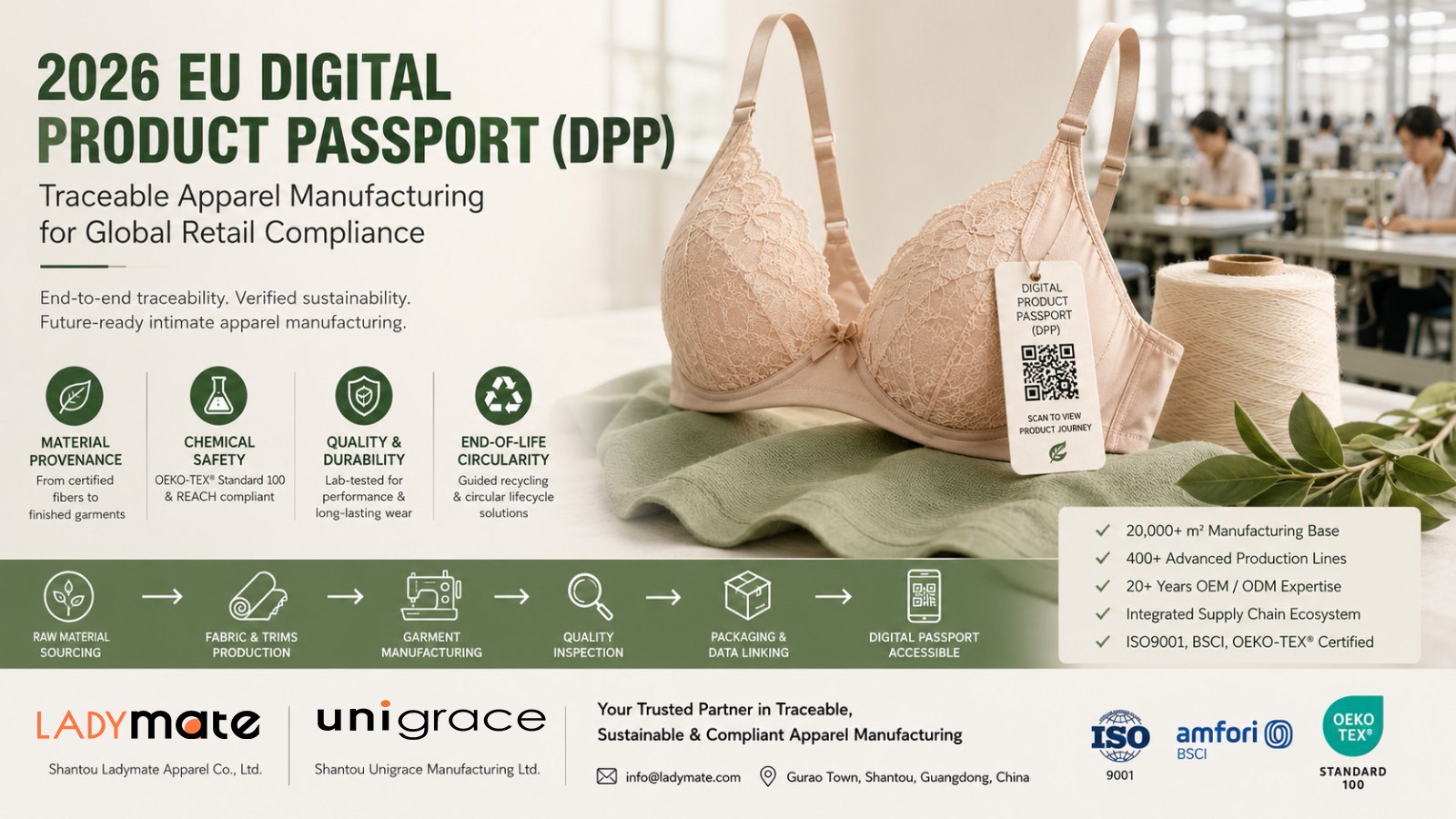
Achieving full data transparency across a multi-component garment requires tight geographic integration among supply chain tiers. Shantou, located in Guangdong Province, China, operates as the world's most concentrated industrial ecosystem for intimate apparel, seamless circular knitting, and stretch activewear fabrication.
In fragmented manufacturing regions, tracing raw materials requires auditing dozens of disconnected spinning mills and chemical processors scattered across different provinces—creating massive data gaps and transit delays.
Within the Shantou industrial zone, high-temperature dye houses, texturizing yarn mills, mold-cup pressing facilities, and hardware fabricators are clustered in close proximity. This hyper-localized ecosystem allows primary manufacturing facilities to collect, verify, and digitally catalog batch data—such as Global Recycled Standard (GRS) transaction certificates and OEKO-TEX laboratory reports—directly at the source, ensuring end-to-end data integrity for global B2B buyers.
Preparing a private label collection for digital passport integration requires embedding data capture checkpoints across every stage of the manufacturing workflow:
The DPP framework mandates granular disclosure of raw material composition. Sourcing teams must track fiber origin—whether verifying that polyamide yarns are derived from certified pre-consumer waste or confirming that cotton inputs originate from non-GMO, certified organic farms with zero pesticide contamination.
Each production lot must be mapped against strict chemical limits (such as REACH and OEKO-TEX Standard 100). Factories must document water recycling efficiency, low-liquor-ratio dye techniques, and energy consumption metrics per kilogram of finished textile.
At the final packaging stage, factories integrate high-durability woven QR code care labels, scannable heat transfers, or passive RFID microchips into the garment. When scanned by customs authorities, retail buyers, or end consumers, the data carrier instantly pulls up the cloud-hosted passport detailing the garment’s material journey and recommended end-of-life recycling pathways.
DPP Requirement Module | Technical Data Parameter | Factory-Floor Verification Method | Sourcing Objective |
| Material Provenance & Composition | Fiber percentages, polymer origins (e.g., GRS Recycled Polyamide 6,6). | Digital Transaction Certificates (TCs) and IQC yarn testing logs. | Verify raw material authenticity and eliminate greenwashing liabilities. |
| Chemical Safety & Health | Zero banned azo dyes, phthalates, PFAS, or heavy metals. | OEKO-TEX Standard 100 laboratory certification records. | Ensure complete safety for next-to-skin wear and pass customs audits. |
| Durability & Physical Longevity | Dimensional stability (<3% shrinkage), colorfastness Grade 4+, burst strength. | Calibrated laboratory tensile and wash-testing reports. | Comply with mandatory eco-design durability and circularity benchmarks. |
| End-of-Life Disassembly Data | Recyclability instructions, fiber blend separation guidelines. | Standardized digital data format linked via scannable QR/NFC care labels. | Facilitate municipal textile sorting and automated mechanical recycling. |
A digital passport is only as dependable as the daily manufacturing disciplines supporting it:
At Shantou Unigrace Manufacturing Ltd., operating alongside our specialized international export arm Shantou Ladymate Apparel Co., Ltd., we have integrated complete supply chain transparency into our manufacturing operations. Backed by over 20 years of OEM and ODM engineering experience, our quality management system tracks every component from initial yarn warehouse intake to final container dispatch.
Our manufacturing base—spanning more than 20,000 square meters and 400 modern production lines—operates under strict digital tracking protocols. We link incoming material inspection (IQC) batch reports, in-line assembly audits (DUPRO), and final Acceptable Quality Limit (AQL) inspection certificates directly to order numbers. This structured data collection enables seamless generation of compliant digital product passports for our global retail partners.
For international brands distributing intimate wear, sleepwear, and swimwear across Europe, North America, Australia, and the Middle East, corporate compliance must be backed by verified international standards:
· ISO9001 Certification: Proves the factory maintains a fully documented, repeatable quality management system that ensures data accuracy and process repeatability across high-volume batches.
· BSCI Certification: Verifies that your private label garments are manufactured under ethical, safe, and socially compliant conditions that strictly uphold international labor rights.
· OEKO-TEX® Standard 100: The benchmark for next-to-skin textile safety. Independently confirms that every component—from performance synthetic fabrics and dyed laces to sewing threads, underwires, and printed QR labels—is certified 100% free from harmful chemical substances.
Meeting global regulatory mandates like the EU Digital Product Passport requires moving beyond basic sewing workshops. To safeguard your retail access, maintain consumer trust, and lead the market in sustainable transparency, you need an enterprise manufacturing partner that combines technical textile engineering, localized supply chain integration, and rigorous compliance infrastructure.
Shantou Unigrace Manufacturing Ltd. and Shantou Ladymate Apparel Co., Ltd. provide the institutional scale, technical precision, and certified quality control protocols required to bring your fully traceable OEM and ODM intimate wear programs to market.
Contact our international commercial trade division today to discuss Digital Product Passport integration, request GRS/OEKO-TEX documentation, or receive a comprehensive manufacturing quotation (RFQ).
· Contact Email:
· Production Hub: Gurao Town, Shantou, Guangdong, China
· Core Competency: Enterprise-Grade OEM / ODM Technical Apparel & Traceability Specialist

Ladymate's mission is to focus on impressing and delighting our OEM/ODM clients through excellent underwears products quality and services while aiming to be a prestigious ladies underwear manufacturer in China and world-wide.


We are here to help you! If you close the chatbox, you will automatically receive a response from us via email. Please be sure to leave your contact details so that we can better assist