Navigating Sourcing Risks in High-Volume Apparel: A B2B Guide to Production Audits, Defect Control, and Vendor Scaling
For international procurement executives, brand directors, and high-volume retail buyers, expanding an offshore apparel program is an exercise in risk management. In high-turnover categories—such as daily briefs, sports bras, seamless activewear, and swimwear—scaling up production from 5,000 units to 100,000+ units per batch exposes every hidden vulnerability in a supply chain.
Without rigorous vendor oversight, enterprise brands face severe commercial risks: fabric lot color shading, inconsistent elastic tension, uncalibrated size grading, and missed delivery windows that jeopardize peak retail selling seasons.
To build a resilient supply chain, procurement teams must look beyond unit price quotes and partner with a technologically advanced manufacturer that operates a transparent quality management system, disciplined shop-floor defect controls, and scalable production architecture.
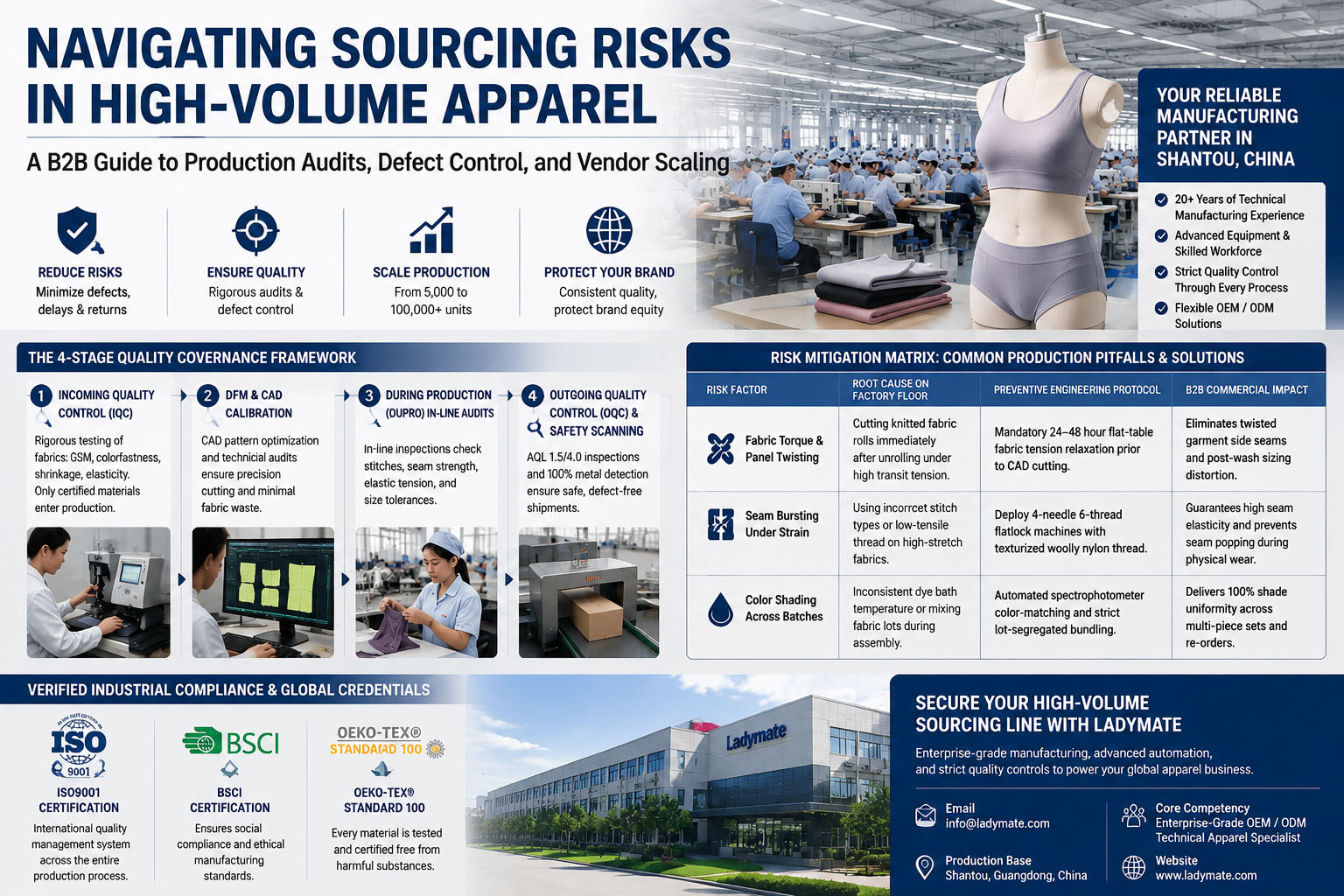
Managing high-volume production risks requires a factory backed by a robust regional infrastructure. Shantou, located in Guangdong Province, China, serves as a premier industrial capital for intimate wear, underwear, seamless garments, and technical sportswear fabrication.
The core advantage of the Shantou manufacturing cluster lies in its hyper-localized supply chain density. High-volume apparel production relies on immediate access to specialized inputs: micro-denier polyamides, high-modulus elastanes, certified eco-friendly dyes, anti-corrosive metallic trims, and custom packaging fabricators.
Because primary factories operate in close geographic proximity to these sub-vendors and machinery technicians in Shantou, production bottlenecks can be resolved rapidly without triggering long-distance shipping delays. For global B2B buyers, this localized ecosystem ensures stable raw material lead times, batch-to-batch consistency, and superior supply chain agility.
To guarantee that mass-produced garments match approved pre-production (PP) samples down to the millimeter, enterprise manufacturers enforce a multi-stage quality control protocol across the factory floor:
Before fabric rolls are released to the cutting floor, technicians evaluate material density (GSM), colorfastness under light/washing, shrinkage ratios, and elastic recovery force using laboratory testing machinery. Uncertified dye lots or sub-standard fabric rolls are rejected immediately at the warehouse gate.
Before bulk cutting begins, pattern engineers perform a comprehensive DFM audit on client tech packs. Using computerized CAD layout software, technicians optimize pattern nesting to minimize raw fabric scrap and calibrate cutting files to account for specific fabric relaxation rates, preventing post-cut panel distortion.
Quality inspectors continuously pull active assembly pieces directly from the sewing lines. Inspectors check critical parameters: Stitch-per-Inch (SPI) consistency, seam tensile strength under stress, elastic band attachment tension, and point-of-measurement (POM) tolerances before garments move to final finishing.
Finished garments undergo final visual inspections based on strict Acceptable Quality Limit (AQL 1.5/4.0) statistical sampling standards. Prior to carton sealing, 100% of packed retail boxes pass through industrial conveyor-belt electromagnetic metal detectors to guarantee complete needle-fragment safety.
Risk Factor | Root Cause on Factory Floor | Preventive Engineering Protocol | B2B Commercial Impact |
| Fabric Torque & Panel Twisting | Cutting knitted fabric rolls immediately after unrolling under high transit tension. | Mandatory 24–48 hour flat-table fabric tension relaxation prior to CAD cutting. | Eliminates twisted garment side seams and post-wash sizing distortion. |
| Seam Bursting Under Strain | Using incorrect stitch types or low-tensile thread on high-stretch athletic fabrics. | Deploying 4-needle 6-thread flatlock machines with texturized woolly nylon thread. | Guarantees high seam elasticity and prevents seam popping during physical wear. |
| Color Shading Across Batches | Inconsistent dye bath temperature management or mixing fabric lots during assembly. | Automated spectrophotometer color-matching and strict lot-segregated bundling. | Delivers 100% shadeuniformity across multi-piece retail sets and re-orders. |
For global retail brands exporting into strictly monitored consumer markets across Europe, North America, Australia, and the Middle East, factory auditing is mandatory to ensure customs clearance, regulatory compliance, and brand protection.
An enterprise-grade apparel manufacturer must maintain three foundational compliance pillars:
· ISO9001 Certification: Proves the facility operates a documented, audited international quality management system spanning raw material testing, shop-floor assembly, and final export staging.
· BSCI (Business Social Compliance Initiative): Guarantees that your private label clothing is manufactured in a safe, ethical, and socially responsible environment that respects international labor rights.
· OEKO-TEX® Standard 100: Critical for next-to-skin garments. This certification independently proves that every thread, lining fabric, dye chemical, zipper, and elastic band is certified 100% free from harmful chemical substances.
At Shantou Unigrace Manufacturing Ltd., operating alongside our specialized export channel Shantou Ladymate Apparel Co., Ltd., we bring over 20 years of technical manufacturing experience to global apparel sourcing. Our skilled product development and quality assurance teams enforce rigorous shop-floor defect controls to protect your brand equity and profit margins across every production run.
Navigating the risks of offshore apparel production requires moving past casual workshop agreements. To maintain reliable inventory replenishment, lower retail return rates, and maximize gross margins, you need an enterprise manufacturing partner that combines a robust regional supply chain, advanced shop-floor automation, and verified global compliance.
Shantou Unigrace Manufacturing Ltd. and Shantou Ladymate Apparel Co., Ltd. provide the industrial capacity, technical expertise, and certified quality controls required to execute your large-scale OEM and ODM apparel programs.
Contact our international commercial trade division today to submit your tech packs for a technical review, request material sample books, or receive a comprehensive manufacturing quotation (RFQ).
· Contact Email:
· Production Base: Shantou, Guangdong, China
· Core Competency: Enterprise-Grade OEM / ODM Technical Apparel Specialist

Ladymate's mission is to focus on impressing and delighting our OEM/ODM clients through excellent underwears products quality and services while aiming to be a prestigious ladies underwear manufacturer in China and world-wide.


We are here to help you! If you close the chatbox, you will automatically receive a response from us via email. Please be sure to leave your contact details so that we can better assist