Navigating OEM vs. ODM Manufacturing for Intimate Apparel: A B2B Strategic Sourcing Blueprint
For international procurement executives, apparel start-up founders, and retail category managers, determining the right manufacturing business model is a foundational strategic decision. In the precision-driven sectors of intimate apparel, underwear, seamless activewear, and functional loungewear, choosing between Original Equipment Manufacturing (OEM) and Original Design Manufacturing (ODM) directly influences initial capital expenditure, product development lead times, intellectual property (IP) control, and speed-to-market.
While OEM allows established brands to retain 100% proprietary design ownership through rigorous technical tech packs, it requires in-house design overhead and longer prototyping runways. Conversely, ODM provides private label retailers with ready-to-scale, factory-engineered silhouettes that dramatically shorten commercialization cycles, but demands strict verification of factory testing standards and sizing adaptations.
Maximizing procurement ROI requires understanding the mechanical, financial, and operational trade-offs between OEM and ODM models and selecting an offshore partner capable of executing both workflows seamlessly.
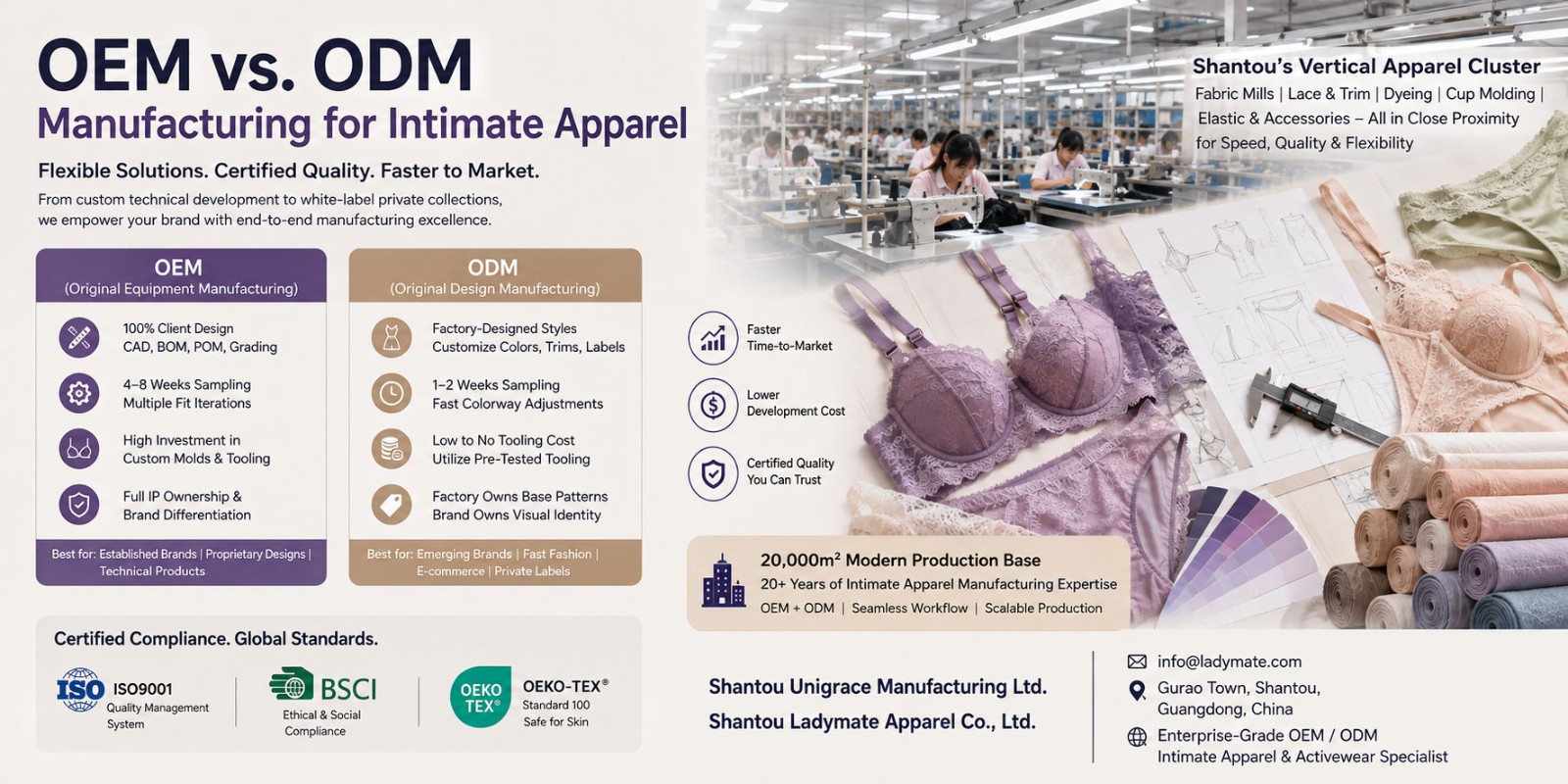
Whether pursuing a custom OEM project or an agile ODM white-label program, the geographical ecosystem of the manufacturer dictates production speed and material versatility. Shantou, located in Guangdong Province, China, operates as a premier industrial capital for intimate wear, circular seamless knitting, and technical apparel manufacturing.
The core advantage of sourcing within Shantou lies in its hyper-localized vertical integration. An OEM tech pack with custom-dyed jacquard lace or an ODM catalog requiring fast fabric substitutions can be executed without delay because high-temperature dye houses, yarn texturizing mills, mold-cup pressing plants, and trim fabricators operate within a close geographic radius.
For global B2B buyers, this localized cluster eliminates transit bottlenecks between sub-vendors, accelerates physical prototype turnaround, and ensures steady component availability for medium and large volume orders.
To select the ideal production pathway, sourcing teams must weigh technical complexity against development resources:
· The Workflow: The brand provides complete 2D CAD drawings, exact Bill of Materials (BOM), Point of Measurement (POM) spec sheets, and grading rules. The factory executes cutting, making, and trimming precisely to the client's specifications.
· Best Applied To: Established global retailers, licensed brands, and technical apparel companies with dedicated in-house technical design teams requiring unique, proprietary fits, custom-molded bra cups, or patented fabric blends.
· Core Benefit: Absolute brand differentiation and total intellectual property control over silhouettes and grading matrices.
· The Workflow: The factory's in-house R&D team develops fully engineered, market-tested base styles (white-label). The client selects existing silhouettes and customizes them via private label branding, custom dyed-to-match (DTM) colorways, print placements, and bespoke retail packaging.
· Best Applied To: Rapidly expanding e-commerce brands, subscription boxes, and department store private labels seeking fast seasonal trend capitalization with minimal upfront R&D investment.
· Core Benefit: Compresses the product launch cycle from 12 weeks down to 3–4 weeks by utilizing pre-graded, factory-proven patterns.
Strategic Parameter | OEM (Contract Manufacturing) | ODM (Private Label / White-Label) | Sourcing Trade-Off |
| Design & Tech Pack Responsibility | 100% client-provided (CAD, BOM, POM, Grading). | Factory-provided base patterns; client customizes color/trims. | OEM demands skilled in-house apparel designers; ODM utilizes factory R&D. |
| Prototyping & Sampling Runway | 4 to 8 weeks (multipl fit iterations & custom molds). | 1 to 2 weeks (minor colorway and label adjustments). | ODM cuts time-to-market by over 60% for rapid seasonal trend capture. |
| Tooling & Custom Mold Investment | High (custom foam cup molds, proprietary underwire dyes). | Zero to Low (utilizes factory-owned, pre-tested tooling). | OEM requires upfront CapEx; ODM lowers initial launch financial risk. |
| Intellectual Property (IP) Exclusivity | Exclusive proprietary property of the brand. | Factory owns base patterns; brand owns visual trademarks. | OEM protects unique design moats; ODM prioritizes volume velocity. |
Modern apparel procurement frequently blurs the line between pure OEM and pure ODM. Leading brands often deploy a hybrid sourcing strategy: utilizing custom OEM engineering for their core hero products (such as signature high-support underwire bras) while leveraging the factory’s pre-engineered ODM styles for seasonal color drops, basic cotton panties, and everyday seamless loungewear.
At Shantou Unigrace Manufacturing Ltd., operating alongside our international trading division Shantou Ladymate Apparel Co., Ltd., we support both operational models across our 20,000-square-meter facility. With over 20 years of manufacturing experience, our specialized in-house R&D team provides an extensive seasonal catalog of pre-tested ODM designs ready for private label customization, while our technical pattern engineers collaborate directly with global enterprise brands to execute complex, custom OEM tech packs.
Our production lines integrate incoming material testing (IQC), in-line assembly checks (DUPRO), and final AQL statistical audits, ensuring that whether producing an ODM private-label run or a custom OEM collection, every piece delivers consistent dimensional stability and fit comfort.
Regardless of whether an order is routed through an OEM or ODM workflow, international export compliance is mandatory to protect brand equity and pass customs scrutiny across North America, Europe, Australia, and the Middle East:
· ISO9001 Certification: Verifies that the facility operates a standardized quality management system, ensuring that repeat ODM production runs and custom OEM batches adhere to identical quality thresholds.
· BSCI (Business Social Compliance Initiative): Guarantees that all private label apparel is produced under ethical, safe, and lawful working conditions that honor international labor standards.
· OEKO-TEX® Standard 100: Critical for next-to-skin intimate wear and activewear. This certification independently proves that every thread, dye chemical, cup foam, elastic trim, and printed care label is certified 100% free from harmful chemical substances.
Navigating the choice between OEM and ODM manufacturing requires moving past rigid vendor relationships. To optimize working capital, accelerate speed-to-market, and maintain rigorous product standards, you need an agile manufacturing partner that provides both custom technical engineering and market-ready private label collections.
Shantou Unigrace Manufacturing Ltd. and Shantou Ladymate Apparel Co., Ltd. offer the institutional scale, technical precision, and certified quality controls required to support your multi-category apparel programs from concept to final delivery.
Contact our international commercial trade division today to review our seasonal ODM private-label catalog, submit custom OEM tech packs for a Design for Manufacturability (DFM) review, or request a structured manufacturing quotation (RFQ).
· Contact Email:
· Production Hub: Gurao Town, Shantou, Guangdong, China
· Core Competency: Enterprise-Grade OEM / ODM Intimate Apparel & Activewear Specialist

Ladymate's mission is to focus on impressing and delighting our OEM/ODM clients through excellent underwears products quality and services while aiming to be a prestigious ladies underwear manufacturer in China and world-wide.
We are here to help you! If you close the chatbox, you will automatically receive a response from us via email. Please be sure to leave your contact details so that we can better assist