Navigating Factory Audits for Apparel Procurement: A B2B Guide to ISO9001, BSCI, and OEKO-TEX Standard 100
For international procurement executives, compliance managers, and enterprise apparel brands, establishing an offshore manufacturing partnership requires far more than reviewing sample quality or negotiating FOB unit costs. In an era governed by global supply chain transparency, strict ESG (Environmental, Social, and Governance) mandates, and aggressive consumer safety regulations, conducting rigorous factory compliance audits is a non-negotiable step in the vendor onboarding process.
Failing to properly audit an overseas clothing manufacturer can result in severe commercial and brand-equity risks: customs seizures due to non-compliant chemical residues, reputational damage from unverified labor practices, or chronic batch rejections stemming from poor factory-floor quality controls.
To mitigate these supply chain vulnerabilities, enterprise brands rely on a triad of internationally recognized certification frameworks: ISO9001, BSCI (Business Social Compliance Initiative), and OEKO-TEX® Standard 100. This guide provides procurement teams with a practical, step-by-step framework for evaluating offshore apparel factories against these critical audit standards.
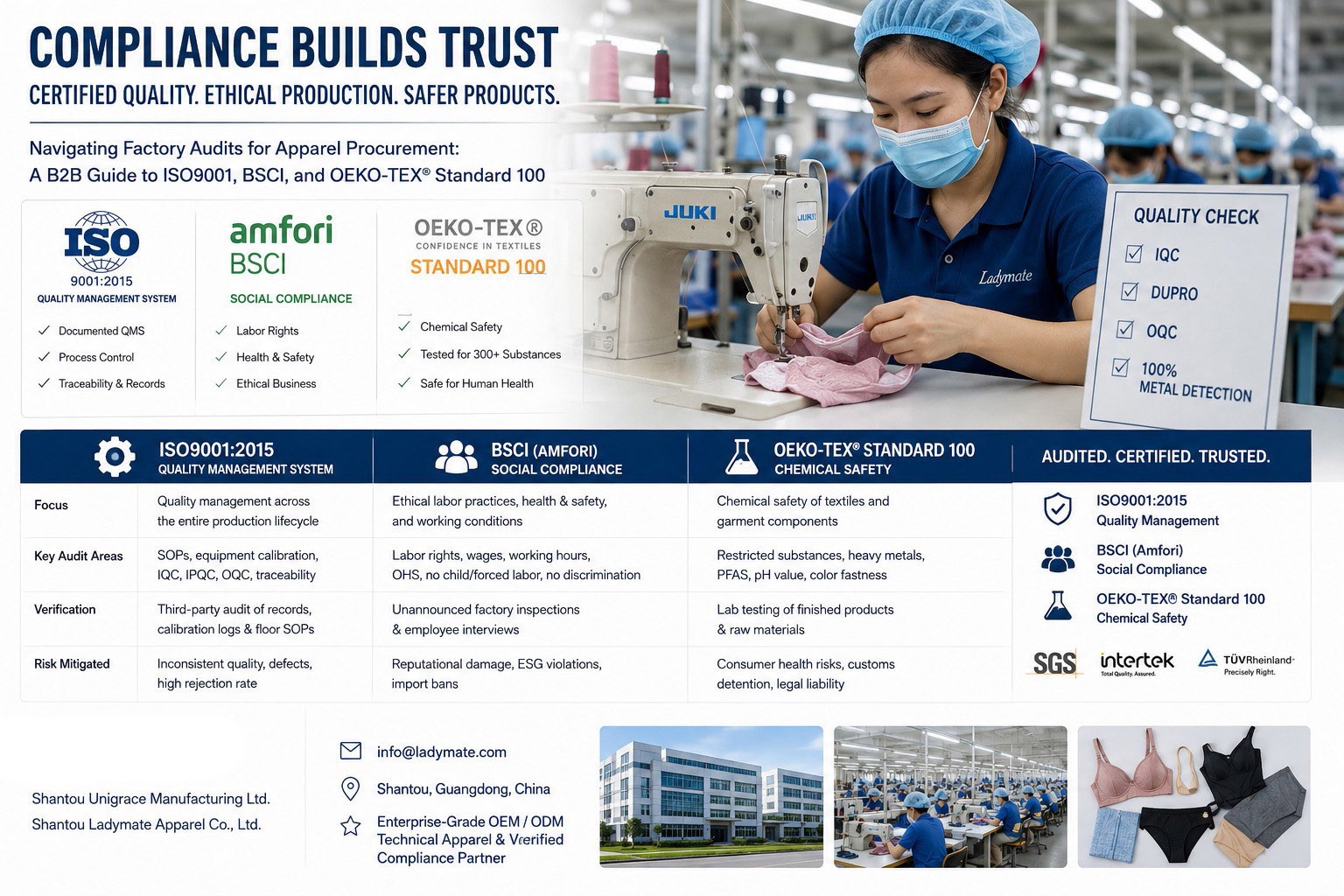
When initiating a vendor audit program, the geographical location of the factory plays a decisive role in compliance feasibility. For technical garments like underwire bras, seamless shapewear, performance sports bras, and swimwear, Shantou, located in Guangdong Province, China, serves as an exemplary industrial cluster.
Unlike fragmented or emerging low-cost assembly hubs, Shantou’s mature apparel ecosystem was built alongside modern international compliance standards. Because primary sewing facilities operate in close proximity to certified dye houses, raw material suppliers, and specialized trim vendors, compliance verification extends seamlessly across the entire localized supply chain.
For global procurement directors, auditing a tier-1 facility within a mature cluster like Shantou minimizes the risk of unapproved sub-contracting and ensures that eco-certifications and social compliance standards are strictly maintained at every step of raw material processing.
Understanding what each audit framework evaluates allows procurement teams to construct targeted supplier evaluation scorecards:
ISO9001 evaluates whether a factory operates a documented, repeatable system for maintaining quality across the entire production lifecycle.
During an ISO9001 audit, third-party inspectors evaluate:
· Standard Operating Procedures (SOPs): Are there clear assembly instructions posted at every sewing station?
· Equipment Calibration: Are fabric tensile testers, digital calipers, and needle-detector machines calibrated and logged on a strict schedule?
· Traceability Protocols: Can the factory trace a defective batch of finished sports bras back to the specific fabric roll, dye lot, and machine operator?
Driven by the Amfori association, the BSCI audit framework ensures that garments are produced under fair, safe, and legal working conditions.
Key pillars evaluated during a BSCI physical audit include:
· Labor Rights & Remuneration: Verification of fair wages, legal working hours, overtime compensation, and transparent payroll records.
· Occupational Health & Safety (OHS): Unobstructed emergency fire exits, proper personal protective equipment (PPE) in dye and cutting rooms, and active workplace safety committees.
· Zero Tolerance Violations: Absolute prohibition of child labor, forced labor, discrimination, or physical coercion.
Particularly vital for next-to-skin categories like lingerie, underwear, sleepwear, and babywear, OEKO-TEX® Standard 100 tests finished products and raw components for harmful chemical substances.
An OEKO-TEX audit verifies compliance against strict global threshold limits for:
· Banned azo dyes, carcinogenic colorants, and heavy metals.
· Phthalates, formaldehyde, and per- and polyfluoroalkyl substances (PFAS).
· Skin-friendly pH levels to prevent chemical burns or contact dermatitis.
Audit Standard | Target Evaluation Scope | Verification Mechanism | Key Risk Mitigated |
| ISO9001:2015 | Internal operational workflows, QMS, incoming fabric IQC, and defect tracking. | Annual third-party audit of factory records, calibration logs, and floor SOPs. | Inconsistent production quality, sizing variance, and high batch defect rates. |
| BSCI (Amfori) | Ethical labor practices, OHS standards, fair wages, and working conditions. | Unannounced physical factory inspections and confidential employee interviews. | Public reputational damage, supply chain ESG violations, and import bans. |
| OEKO-TEX Standard 100 | Chemical safety testing of every raw component (fabric, threads, elastics, prints). | Laboratory testing of physical garment samples against 300+ harmful substances. | Consumer health reactions, customs border detentions, and legal liability. |
A compliance certificate is only as valuable as the daily shop-floor discipline that supports it. At Shantou Unigrace Manufacturing Ltd., operating alongside our international export division Shantou Ladymate Apparel Co., Ltd., we view international compliance as the foundation of our manufacturing operations.
With over 20 years of technical manufacturing experience, our production lines operate under strict, audited ISO9001, BSCI, and OEKO-TEX Standard 100 protocols. Our internal Quality Control division enforces incoming material inspections (IQC), during-production checks (DUPRO), and 100% metal-detection passes during final packaging (OQC).
By maintaining active, transparent audit reports with accredited international testing agencies (such as SGS, Intertek, and TÜV Rheinland), we provide global buyers with complete supply chain transparency and peace of mind.
Building a resilient global brand requires choosing manufacturing partners that prioritize ethical standards, product safety, and technical consistency. By establishing clear audit scorecards and partnering with fully certified OEM/ODM factories, your business can protect its brand reputation, satisfy international regulatory bodies, and deliver exceptional apparel to consumers worldwide.
Shantou Unigrace Manufacturing Ltd. and Shantou Ladymate Apparel Co., Ltd. offer the institutional scale, technical precision, and certified compliance infrastructure needed to anchor your global private label programs.
Contact our international business division today to request copies of our current audit certificates, submit your vendor onboarding questionnaires, or arrange a third-party factory inspection.
· Contact Email:
· Production Hub: Shantou, Guangdong, China
· Core Competency: Enterprise-Grade OEM / ODM Technical Apparel & Verified Compliance Partner

Ladymate's mission is to focus on impressing and delighting our OEM/ODM clients through excellent underwears products quality and services while aiming to be a prestigious ladies underwear manufacturer in China and world-wide.

We are here to help you! If you close the chatbox, you will automatically receive a response from us via email. Please be sure to leave your contact details so that we can better assist